Showing posts with label grief. Show all posts

Monday, April 02, 2018

A round life

Yesterday morning I stood before a small audience of supportive strangers and read a poem I’d written a couple of months ago. It was about connection, tenderness, anniversaries and the hole that is left behind when somebody dies. Reading it aloud, my hands shook but my voice was strong. Being vulnerable, and connecting with my audience, felt brave in a really good way.


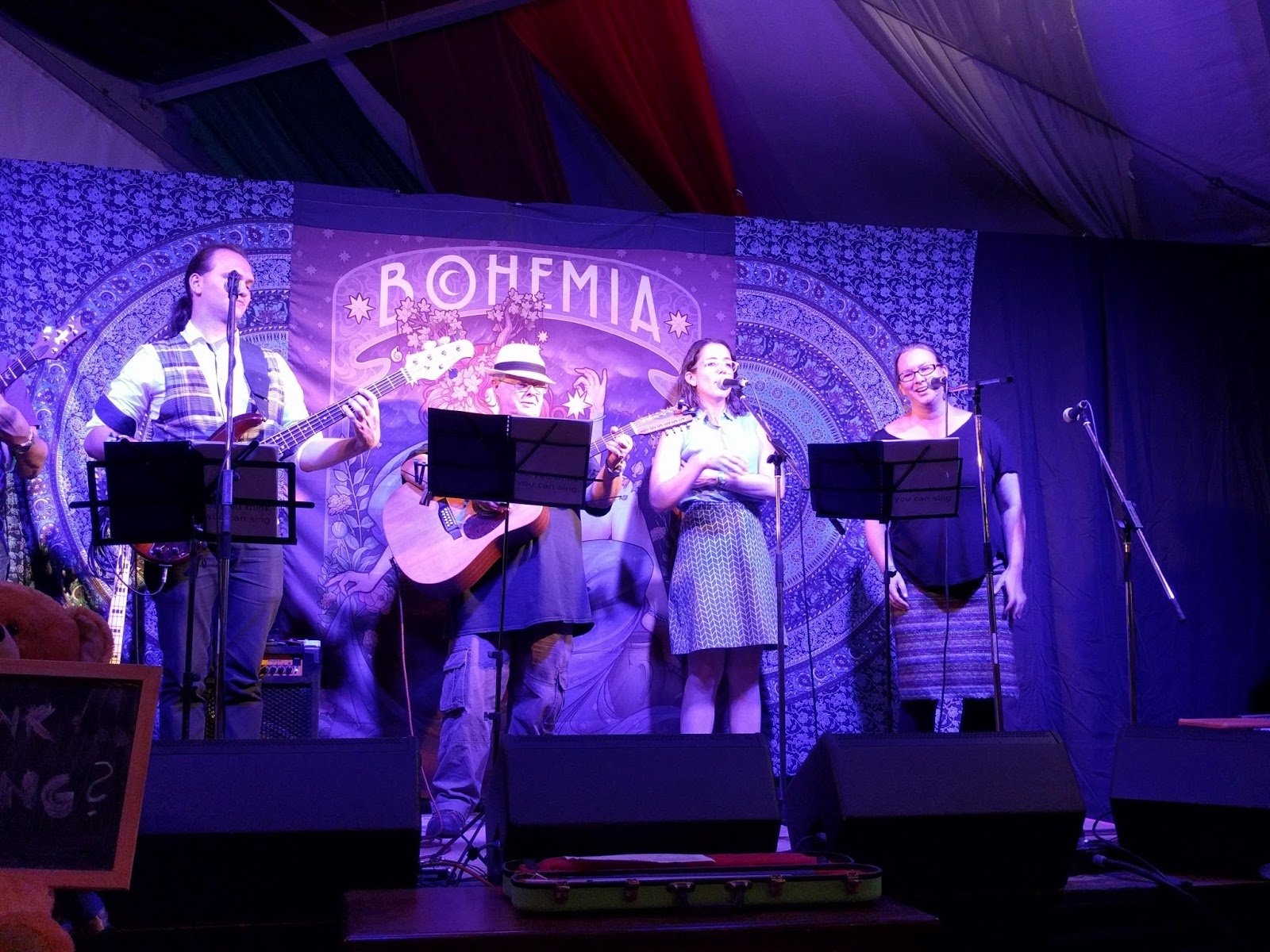
Karaoke at the Bohemia - another little act of courage

This weekend has been all about bravery and connection and creativity for me. As well as the poetic recitation, I’ve danced with abandon to the tunes of a contemporary brass band, strummed on my ukulele with a new friend, listened to beautiful music, laughed uproariously with old friends, sung karaoke with the assistance of a backing ensemble, and slept peacefully on the grass. I found myself in deep conversations about leadings, learnings, gender equality in the hair cutting business, the search for love, bad legislation, time management, and the eternal quest for meaning.

It seemed perhaps even more important to be creative, connected and brave as this weekend marks the ten year anniversary of David’s death. A decade ago there was another gaping hole left behind, another grieving spouse, and another set of communities making their way through the fog of uncertainty and pain. Yet, it was also the beginning of a journey of self-discovery, deeper friendships and creative pursuits for myself and others. And at David’s funeral all those years ago, I read a poem by Michael Leunig about living a spacious and round life, not necessarily a long one.


Poem I read at the funeral
What I've learnt from the past decade, and particularly from the past few years, is that while we can't control whether bad things happen, we can control the way that we reach out to others, show our vulnerability, and provide support and kindness at those times. These are the true measures of our humanity. Simple acts of love that have meant something include attending a funeral for the grieving not the deceased, quietly arranging transport, being there waiting in the rain, offering a place to stay, being okay with looking at ashes, bringing soup, and taking long, companionable walks where nothing particular is said.

So, as I think of those touched by more recent loss, I realise that opportunities to be brave, to connect more deeply, to move in surprising directions, to explore creativity, and to live a round and spacious life, can arise from the depths of suffering. This weekend I honour all those courageous, vulnerable and strong people who’ve chosen to live their lives with integrity, filled with creativity, love and joy.

Thursday, July 14, 2016

Between the sheets

* He's had a crush on her for years. She needs a place to crash after a big night. He just assumes she's fine with it.

* Eventually, after much begging and pleading, she reluctantly agrees to let him kiss her.

* Sharing a bed, she asks that there be no kissing or sex. But he gets a bit carried away.

* He knows she's slept with other guys, so why not him? They're dating, after all.


When the open letter from the victim of the Stanford rapist came into our consciousness, almost every woman I know was reminded of a story of her own, buried away in the depths of her memory, or perhaps from not so long ago, where consent was not enthusiastically given, or boundaries were crossed, or trust was abused. In many cases, shame or a wish to "just move on" prevented any further action being taken. 

Reading the story of what this particular woman went through, both immediately following the rape and then in the re-living of it during the court case, has led me to reflect deeply on the meaning of consent, and the prevalence of slut shaming and victim blaming in our society still to this day. So often we women doubt ourselves and each other because society wants to couch us as "promiscuous" or "drinking too much" and men as "nice guys" with "a promising career ahead" who "made a bit of an error in judgement".

Brock Turner's lawyer and his father made outrageous attempts to minimise the impact of the incident on the victim and highlight the impact on the perpetrator. This behaviour shows just how warped our society has become when considering matters of consent, gender based violence and sexual abuse. 

Possibly the only positive coming out of this horrific incident is that people are starting to talk, to share stories, to realise that they're not alone. Because of this one woman's courage, and the actions of those who found her and called the police, more people around the world might feel just a little more confident about holding others to account for their actions and demanding respect. 

When I shared the woman's open letter on facebook a few weeks ago, a male friend contacted me quite distraught. After reading it, he had conducted a brief survey of his female friends, and discovered that a high proportion had experienced some kind of related incident at one time or another. He was horrified. With a very young daughter of his own, he could not believe what his sex was doing to hers. He wanted to know what he could do about it.

So I think I talked about shifting the burden of responsibility from women to men. I might have said how we need to educate men about consent, and about respecting boundaries, and how to extricate themselves from the rape culture that makes these so-called "minor indiscretions" permissible and justifiable. We can teach women about saying no, or the skills of self defense or assertiveness, but ultimately it's men who need to make the biggest changes.

But actually, I just felt kindof numb. I was glad to have an ally, and grateful for the numerous male friends who have "got it" over the years, or who have at least been willing to listen and try to understand. But when women choose to speak out about these matters, they are putting themselves in a place of great vulnerability. I wonder how we can make this journey easier, so that difficult experiences are genuinely listened to and everyone involved can reach a place of greater understanding?

Friday, September 04, 2015

Under wraps

"Can you keep a secret?" I type the text message, then pause. I've been told that the news is embargoed until Monday, but I'm eager to tell someone. After staring at the words for a few minutes, I decide not to send and the message just sits there as a draft. There have been a few occasions recently when I have hurt others by revealing secrets that, while having an impact on me, are not mine to tell. I've also experienced that sinking feeling when you realise a trusted friend or family member has told one of your secrets to somebody else.

It got me thinking about secrets, though. There are pieces of juicy gossip, skeletons in the family cupboard, confessions we tell a lover, and those shocking revelations that only come to light after a person dies. These days we think of our society as generally being less secretive than it was even half a century ago. Unwed mothers are no longer sent "down south for a while" in a veil of shame, we don't hide our political beliefs as reticently as our parents did, and people don't disown you if you come out as gay. But there are a lot of things we still like to keep hidden.

I have been thinking lately about mandatory reporting, and the times when there are not just emotional but legal implications of keeping and telling secrets. We are seeing the life-destroying impacts of institutional child sexual abuse coming out of the Royal Commission. And, the continuing theme in those historic incidents was the secrecy surrounding it. Children were encouraged to keep the incidents a secret, and mostly they did - for a very long time. Perhaps they kept quiet under threat of violence, perhaps because they didn't feel they would be believed, or perhaps for fear of what would happen to the perpetrator.

I remember reading the memoire of a woman who had been groomed as a child for a sexual relationship with a much older man. He showed her attention and kindness that other adults didn't, and they increasingly found ways to be alone together. She was eight when the first incident happened, eleven when things got more serious, and eighteen when she began to break away. He died when she was in her early twenties. Writing the memoire many years later, she could reflect on why what he did was wrong, how it impacted her, as well as the circumstances of her life that meant she was particularly vulnerable to the abuse. She had kept the relationship a secret throughout their time together.

The Royal Commission reveals, if nothing else, that child sexual abuse is far more prevalent than any of us could have imagined, and its effects are still strongly felt by survivors half a century later. These are secrets that need to come to light in order to give a sense of justice and closure to survivors.  We need to shift the culture in our institutions from one of turning a blind eye to one of open-ness and of acting swiftly and professionally to address issues before they escalate. We need to send a clear message about what sort of behaviour is appropriate and what is not, especially when it comes to children.

So, I think about the secrets in my life. The ones I've told and the ones I've kept hidden for many years. I'd like to get better at knowing when to tell and when to refrain, who to trust and whose trust I need to earn back. Sometimes the unsolicited sharing of a secret can spell the end of a friendship. Other times it's just a blip in the road. And sometimes telling a long-held secret can be a way to find healing and comfort, and bring two people closer together. 

And as for that embargoed piece of news? Well, I'll tell you on Monday.

Thursday, January 15, 2015

Well read and intellectually fed

Amid glasses of wine placed precariously at people's feet, bowls of soup balanced on knees and almost enough seats for everyone, the first meeting of the Women Author's Bookclub commences. As the discussion moves from style to character development and on to an animated debate about what actually happened in the end, I feel a sense of gladness. Yes, this is what I had in mind.


The idea for this particular bookclub was a few years in the making. At the end of 2012 I set myself three intentions and one was that I would join a bookclub. It seemed like a good way to nurture my mind. About a year later the bookclub thing came to fruition. Having heard about a movement of people choosing to deliberately and only read books written by women, acknowledging that by default we tend to read books written by men, I decided to take the matter into my own hands. I started a women authors' bookclub!

Having never even attended a bookclub myself before, I had to google how to go about it. I wanted the group to be egalitarian in its decision making, and for everyone to take turns hosting, choosing the book, and facilitating the discussion. I wanted it to be fun, as well as intellectually stimulating. I mentioned the idea on facebook, and suddenly a whole bunch of my friends wanted to be involved, and so the Women Author's Bookclub was formed.

We've read a range of books. Some memoire, some fiction. We've covered Australia, USA, Nigeria, Kenya (briefly), Sri Lanka, Germany, England and France. We started in Australia, with our friend Chrissy Howe's "Song in the Dark" about a boy and his grandmother. The novel covered issues of drug addiction, hope and family connection. Then we read "All that I am" by Anna Funder. This followed anti-Nazi activists from Germany to London where life as political refugees is challenging to say the least. The main character reminded me of an activist I know, and her commitment led us to consider the lengths we would go to for a cause we believe in.


Next, we seemed to read a string of quite heavy books about race and/or sexual abuse. "Caleb's Crossing", by Geraldine Brooks explored life in the early settlement days of North America, through the story of the first Native American man to go to University, told from the perspective of his closest childhood friend.  Alice Walker's "The Colour Purple" took us through the life of an African American woman in the deep south, told through her letters to her sister who is in Kenya. This woman faced abuse from her step-father and husband, but eventually found a way to create a sense of family and build self-confidence in herself and the women around her. "Two or three things I know for sure" continued the theme of sexual abuse, exploring how one white woman came to navigate life after rape, while "Americanah" by Chimamanda Ngozi Adichie continued the theme of race, with the story of a woman from Nigeria who came as a student to America. The thread running through this story was her relationship with her childhood sweetheart, whose life takes a very different path to hers.


"Plains of Promise" by Alexis Wright took us back to Australia, with journeys in and out of remote Aboriginal communities, in an attempt to understand an Aboriginal woman's heritage and connection to her spiritual power. For something quite different, we read "The elegance of the hedgehog" about a well educated and cynical concierge in a bourgois hotel in France. It is the arrival of a Japanese resident that changes how everybody sees one another. Our next book was Michelle de Kretzer's "Questions of Travel", which explores the parallel lives of a white Australian woman who travels around and lives in Europe and a Sri Lankan man who seeks asylum in Australia. And we ended the year with "Wild" by Cheryl Strayed, which follows a white North American woman on a journey of self discovery as she hikes her way across the Pacific Trail following the death of her mother and breakdown of her marriage. 


All of these books have been really good reads. I particularly valued the fact that I got to partake in books that I wouldn't necessarily choose for myself, although i still found them all really interesting, well written, and engaging. I did notice that women write of pain and suffering in a particularly knowing way, and I'm glad I had others to share and reflect on this experience with. So, we're yet to see if the bookclub will continue, whether it will take on a new theme, or fade away. But whatever the outcome, I am so glad we did it! I feel incredibly grateful that I had the opportunity to read those books. 

Saturday, August 23, 2014

Perfect match

Almost as soon as I open the email I know. Its another "Dear Aletia..." letter. Something to do with a crazy ex-girlfriend and needing space. At least this time I am granted the right of reply, and am able to wish him all the best before whatever it almost was, isn't any more, and we cease contact. He was a lovely guy, and I'm sad.

Yep, I am starting to think I have a little too much in common with unlucky-in-love Rachel from Friends and George from Seinfeld. As I accrue a collection of "meh" first dates, a few promising second dates gone just a bit wrong, and add a couple of friends turned lover turned stranger scenarios into the mix, I start to realise that at least I have some interesting stories to tell.

I was talking with a colleague the other day about how job searching is kindof like dating, except that for some very practical reasons (ie money) you don't want to be "unattached" for too long. Like dating, though, first you have to get the profile/resume right, then you go for the date/interview, and then, at least in my recent dating experience, one of you attempts the delicate art of gentle rejection and the other tries their hand, with varying levels of success, at graceful acceptance.

With these thoughts in mind, I am marvelling at how pleasant it was to have a different conclusion to my first foray into the job search process. I had completed steps one and two, and knew that I was still interested. So, it was with a little surprise and much delight that I learnt that the feeling was mutual. I was being offered the job! My new boss even confessed later on that she "knew" almost as soon as she read my application. Wow, maybe there is such as thing as a job match at first sight.

So, as I weigh up dating disappointments against employment euphoria, I can't help but feel lucky overall. We spend 8 hours a day at work, and longer if we're travelling, so it is important to feel valued and, as the Quaker advice goes, that you have taken "the path offering the greatest opportunity for the use of your gifts in the service of God and the community". I feel good about the change.

And as for dating, Quakers have some advice on that too. "In close relationships we may risk pain as well as finding joy" the advice reads. "When experiencing great happiness or great hurt we may be more open to the working of the Spirit". I agree. To be fully alive, you have to be willing to risk pain. And there have been some special and joyful moments. Even when experiencing a sad goodbye or the hurt of realising somebody you care about is just not that into you, it is still part of the beautiful and complex experience of being human, for which I am endlessly grateful.

Friday, August 22, 2014

Oh captain my captain

My favourite movie for many years was "Dead Poets' Society". Being a drama student I guess I felt I could relate to some of what the boys went through. Theatre was my mode of self expression, and I was also trying to find that balance between being brave and seizing the day, while at the same time being expected to fit in with societies norms and structures.

The film was also my first introduction to Robin Williams, and he quickly became a favourite actor of mine. I loved the passion, the integrity and the courage of his character in Dead Poet's Society - I, too, wanted to be challenged to rip out the pages of the textbook, emerse myself in poetry, express anger wholeheartedly and be encouraged to go think for myself.

In many of his roles Robin Williams seemed able to capture complex elements of the human spirit, whether it is the heartbroken yet tough-love psychologist in Good Will Hunting, desperate father in Mrs Doubtfire, or radio presenter in Good Morning Vietnam. And his comedy always had a depth to it.

The most memorable scene in Dead Poet's Society for me was the one where Robin Williams' character returns to collect a few personal items after he has been asked to leave the school quietly. He has been scapegoated as the cause of his student's suicide death and the class has gone back to using the textbook and thinking within the box. You begin to wonder whether the teacher had any impact at all. But one boy dares to stand up, to express his gratitude and sense of injustice as a small act of civil disobedience, and gradually the others follow. I am always in floods of tears at this point.

So, as I mourn the departure of a man whose life work touched so many people, I give thanks for the ways that he made us laugh, encouraged us to seize the day, and bore witnessed to the complex realities of being human. I want to stand up on my desk and address him with the respect he deserves: "Oh captain, my captain".

Saturday, June 28, 2014

Another

I heard the news the other day
Another gentle soul
Made a devastating exit

He is added to the collection
Of young men whose lives
Are consumed by the black dog

I remember those already gone;
Artists, dreamers, wanderers
Who loved with big hearts

And i try to find a way
To be there, again, be real
When all I feel is numb

Saturday, May 10, 2014

Lost and found

This is the story of my long lost brother.

The tale of how he came about really begins with two teenagers in the summer of 1963, but as far as I was concerned it all started with a 7 year old girl twenty years later and her unwavering wish for an older sibling.

You see, I had been wishing for siblings since I was about 3. When I was 5, I got two younger ones, and since that worked out so well, I decided it would be nice to have an older one too; somebody to stand up for me, to advise me, and be in solidarity with me during those difficult teenage years.

When I was 12 my wish was granted. An older brother had materialised and wanted to meet us. When dad told me the news, that he'd had a son when he was 19, and this person had been in touch, I burst into tears. Partly sadness that I hadn't known about him before,  partly happiness that I had an older brother after all, and partly a knowledge, as far as my young mind could comprehend, that this new information was big and complicated and was going to change how I saw the past and the future.

Andrew on a visit to Sydney,  circa 1992

My new brother was 24 years old - positively ancient as far as I was concerned, and already had a mum and dad who had raised him and a sister. He also had a new biological mother to get to know. Plus he lived in Melbourne. None of these factors were conducive to the instant solidarity and closeness that I had been expecting. But I retained an open mind.

I can't remember much of what we talked about that first meeting. We probably shared family photos, he must have mentioned his work as a librarian, and I think dad made plans for him to meet the grandparents. I suspect us kids were asked to give a short violin recital. I do remember him telling me that he used to really annoy his sister when they were teenagers, and I filed that away as evidence that maybe I had gotten the best of both worlds after all. Everyone thought he looked more like Uncle David than any of us, although he did share dad's strong dislike of capsicum, which gave a certain validity to dad's claims that it was a genuine health condition.

Overall, dad was just stoked that his son hadn't turned up as some tattooed bloke on a motorbike. That seemed to be his main fear, so it must have been comforting to see that Andrew is undecorated and prefers 4-wheeled transport. The other fear was that Andrew and I would meet, fall in love, then discover we were related and end up on "The Oprah Winfrey Show". That was thankfully no longer a concern either. We also learned that he is incredibly considerate, sociable, thoughtful, tells a great story and has an exceptional memory for people and places. None of us could have asked for a more delightful long lost relative.

And so began the getting to know you process. He sent us birthday cards, and if he was in Sydney or any of us were in Melbourne, we would meet up. He gradually became part of our lives, not wanting to intrude too soon, and for many years was something between a cousin and a good friend. Since we never lived together as siblings, I still think of myself a little bit as an eldest child. And besides, his sister in Melbourne has the only legitimate sibling claim over him because of all the teasing she put up with during adolescence. We have to respect that, but I did feel extremely proud introducing my new brother to friends and relatives at my 21st. He and Richard had flown up 'specially, which meant a lot to me.

In my twenties during a visit to Melbourne I asked Andrew and Richard about the secret of their relationship success. It was a tentative request for brotherly advice. They celebrated 20 years together just last year, and are one of the happiest couples I know. "Oh, I think it helps that we're boring" Richard offered, after a longish pause. "Yes" agreed Andrew. "I like looking at open houses and Richard likes seeing planes take off. We do those things together". I have yet to find a direct application of this advice to my own life, but was very glad to receive it.

Six years ago, Andrew and Richard moved to Sydney and bought a house just a short walk over the creek from mum and dad's place. While they were house hunting, Andrew stayed with my parents, and he and Mum bonded over beautiful sunsets, chats over a morning cuppa and a love of books. Since then there have been plenty of opportunities to connect more. At family get togethers Andrew and I enjoy entertaining others by carrying on a conversation in pidgin English or giggling and gossiping about the antics of each other's friends and family. When we reminisce about the early years, Andrew will remind me that when we met I was 12 whereas the twins were only 6, and I feel like one of "the older ones". We have the solidarity thing that I always wanted. It's turned out very nicely.

Well and truly part of the family, 2013

So, here we are 25 years later. Am I glad he wanted to find us? Only on a daily basis! Would I have liked to know about him earlier? Kinda! Just like Tom Cruise's character in "Rain Man", I sometimes feel it just would have been nice to know that I had a brother. But over time the lost years diminish in proportion to the found years and it matters less. Instead of regretting what we missed, or how things could have been, I am just so glad he is in my life now. And it is a reminder that even the most unlikely of wishes can come true!
Friday, April 04, 2014

Truth telling

Somebody shared a Virginia Woolf quote the other day: "a feminist is any woman who tells the truth about her life". I have been thinking about this, because I recently told the truth about my life and didn't get the reaction I wanted. And I'm okay with that.

The truth is not always easy to hear. We don't want to find out that our idols or family members or partners are fallible and have human frailties. There are things I've done in my life that I'm not proud of, and I'd like to be able to tell those stories truthfully, without judgement. I've also found that people don't want to hear about hard stuff, messy stuff, and raw emotions. It takes courage to share those things, and courage to hear them.

I'd also like to be able to tell the truth about what has happened to me, the times when I have been hurt, or really vulnerable. Often, when it comes to a story about my life, whether it happened when I was a child, a decade ago, or last week, I've already been on a journey with the story before the time of the telling. I've been angry, sad, and confused. But normally when I come to the point of telling others the story, especially new friends, I've still got lots of those emotions associated with the story, but I'm okay with it. I forget, though, that sharing a story is a two way thing. Sometimes I tell it flippantly, or carelessly. Sometimes I don't think enough about how it's going to affect the other person, whether they've got enough resilience to deal with it, and also whether I've put enough of my own armour on or built up enough trust with the other person before I make myself vulnerable in that way. 

But I guess a feminist, or any person wanting to live with integrity, keeps on telling the truth about their lives, even if it's hard. The trick is to get better at knowing when, and how and why we're sharing that information about ourselves. And then to be able to live with the reaction.

Sunday, February 23, 2014

Letters I've written

Now, this is going to make me sound really old, but in my day we didn't have facebook or email or skype - we just wrote one another letters... lots and lots of letters. During my teenage years, I corresponded with friends in other cities, love interests, boyfriends, mentors, pen friends overseas who I'd never met, and school friends who I saw every day. It was the way we expressed ourselves, and how we connected.

There is a box at my parents' place full of letters that I received, and cherished. This little box of treasures provides a glimpse into the 1980's teenage experience, expressed through the people I was communicating with. There are tentative reflections in french on a memorable night, angsty post-break up letters complete with lyrics from REM, tales of road trips and overseas travel accompanied by photos, drawings and mixed tapes, queries about life's purpose, declarations of love, and secrets shared that I have never disclosed. Boy-crazy letters and girl-crazy letters. Letters on pretty paper, neat paper, and on the back of recycled paper. Letters that followed ruled lines, and others that whirled across the page in a spiral. That was the great thing about those letters - there were no rules, and each person's style of writing and choice about the packaging said as much about them as the words they wrote.

While I hold some of the letters written to me, those I wrote are scattered around the world. I have since wondered who kept them, what they meant to the recipients, what I was saying back then, and where they will end up. After my grandfather died, and we were methodically and painstakingly going through his possessions, I stumbled upon a Valentine's Day card Grandma had written him early on in their marriage, when she was not much older than I was at the height of my letter writing era. I felt like an intruder into a time and intimacy that I hadn't been privy to before. I guess that's what happens with letters - sometimes they outlive those who cherished them.

After my friend David died, Lisa told me she had some of the letters I had written him over the years and that I could have them back if I wanted. He had kept them for over a decade. For those years since he died, I didn't feel ready to read them, perhaps scared to discover myself there - raw in black and white. What if I wasn't how I remember, or I don't like that girl? But one day I will read them, and like a voyeur again, I will be transported back into the experience of my 21 year old self, a girl who might seem as distant from my "today" self as the newly-wed woman was to my Grandmother. But that's the thing with letters...

Saturday, January 25, 2014

Utopia

The other night I saw John Pilger's film "Utopia" at The Block in Redfern. Arriving late, I was wondering whether I'd find anyone to sit with or whether I would miss the beginning, but I needn't have worried. It seemed that Sydney's entire progressive community had turned out to see the film. The movie itself didn't get started until I was well and truly settled into my picnic spot surrounded by people I knew.

Photo taken by my friend Costa

At the beginning of the documentary we learn of the price people are willing to pay to stay one night in a luxury apartment by Sydney's breathtakingly beautiful harbour. This opulence is then juxtaposed with Utopia, a remote desert community just a few hundred kilometres north of Alice Springs, where a health worker describes the appalling conditions that people live in. In one particular house, the only toilet doesn't work most of the time meaning that raw sewage collects in the back yard, and they don't have the basic medical supplies for immunisations or to prevent diseases that are non-existent in the rest of Australia. Oh, and cockroaches have been found in children's ears.

The description reminded me of an incident in Balgo, another desert community set on the intersection of Warlpiri, Kukatja, and Ngarti lands a couple of hundred kilometres further north, where I journeyed in 2009 to attend The Kapulalungu Aboriginal Women's Association Law Camp. Arriving in town, I remember one of my travelling companions commenting loudly about the state of the sleeping quarters, citing cockroaches, dog poo and unwashed dishes scattered about the place as unacceptable, perhaps unaware that while our new room-mates might have been too shy to speak English with us, they understood the gist only too well. We were perpetrating again the shame we place on First Nations people because they are not like us, or because they don't have access to the basic sanitation facilities that we take for granted.

In that community I formed a bond early on with one lady who had recently lost her son to suicide. He was the third young person to die that way in the space of 12 months. As we shared snippets of our very different lives, I marvelled at her resilience. Some of her older female relatives remembered a time pre-invasion, before the middle generation had been raised in a Catholic mission school away from their families and prevented from speaking their language. These women were now teaching their traditional laws and customs to the younger and middle generations with the hope that re-connecting to culture would make a difference to self-confidence, cultural pride and a sense of healing for the community as a whole. Even after sixty short years, "settlement" had clearly been very destructive to the mental health of young people, evidenced in the high rates of suicide.

One of the buildings used for health and community work, Balgo

Rates of youth suicide amongst First Nations people was highlighted in the movie, with Robert and Selina Eggington from the Nyoongar Nation speaking about their own experience of grief losing a son to suicide, and then talking about a space of remembrance that they created for other grieving parents in the Perth area. I wished the movie had included more positive stories like this, and perhaps more from urban and rural experiences as well as remote. But I did find it valuable to hear about successful strikes and union activities that had led to increases in wages, improved standards of living and safety for workers. Stories of resistance movements and urban survivors could have been more prominent.

The irony in the connection between the Northern Territory Intervention and the Stolen Generation was explored. John Pilger reminded us that the Intervention was supposedly implemented because of John Howard's concern about rape of children by Aboriginal men in Northern Territory communities following the "Little Children are Sacred" report. Yet, such allegations were a complete misrepresentation of the report. Even more frustrating is the irony that it was the rape of Aboriginal women and girls by white men that resulted in the "half-caste" children who were stolen as part of a racist policies to breed out the black. Some of the books that tell the stories of the stolen children are so powerful, and I remember tears streaming down my face as I learnt of each person's unique but similar heartbreak. Since I was aware that my grandparents had fostered an Aboriginal girl in the 1960s, believing they were doing a good thing, I imagined with some discomfort every story taking place in their house.

The racism of newcomer Australians is evident in interviews with former politicians, people celebrating Australia Day, and countless stories of unnecessary deaths in custody and massacres that have gone un-noticed in history books. I am also disappointed by how this country has handled Australia Day, almost completely oblivious that our day of pride represents nothing less than invasion day for First Nations people. My sister-in-law tells me that she was shocked by the racism she noticed amongst settler Australians when she first moved here. As I continue to struggle with my own racism and privilege, I am filled with love for the First Nations people in my life who have opened their hearts to me over the years. I have a number of "uncles" who continually forgive me as I stumble and offend. They gently nudge me in the right direction.This movie is another step on my journey. I hope it is seen by those who need to see it, rather than only those of us who are "the converted" -  those of us well-intentioned lefties who want to be supportive, but still need a great deal more educating, mind you! And I hope this story will spark vigorous discussions. I reckon it's okay if we don't all like the style of journalism or the choice of content, as long as it gets us talking about our embarrassing history, the change we want to see in the future, and maybe even taking action in our own lives to be that change.

Monday, October 07, 2013

Bandaid solutions

Over the past few days I have had a rather high number of paper cuts. I think they must be 'going around'. Because of the disproportionately high level of discomfort caused by such small cuts, I have taken to applying band-aids and this got me thinking about the old band-aid analogy.

I am pretty sure there are two types of people. Those who like to rip band-aids off quickly, and those who prefer to peel them off bit by bit over the course of a number of days/weeks/months. I have a lifetime membership of the latter category. As a child I would take a daily stocktake of the state of the knee and its covering, taking a significant amount of time out of my busy schedule (not) to work on the task of gently separating the two, bit by bit. Being a deliberator and a 'thoughtful' person, I am not one for hasty decisions and have always hoped that if I peel slowly enough, the pain will be diluted to the point of being unrecognisable as pain.

This year I have learnt that the same band-aid solutions tend to be applied to matters of the heart. Some people prefer to take quick and decisive measures while others like to linger. Even when all logical and practical indicators point to the fact that the band-aid needs to come off at some point, I still prefer to peel it off gently, hoping again to dilute the pain. Probably frustrated with this situation of band-aid “no-man’s-land”, I have had the band-aid unceremoniously ripped off once or twice by the other person, in the same way as a frustrated mother who is tired of watching that child painstakingly edge the flapping and grubby plaster from their knee will swoop in and rip! And, like the small child, I am left a little bewildered and unsure about whether to be indignant or secretly relieved.

This state of affairs has left me wondering whether there are in fact times when it's better to just "rip" and get it over with. Perhaps ripping is not so bad. Maybe it can be freeing, and positive, and bold. So, in an unprecedented move, I decided to rip off the band-aid that had been on my paper-sliced finger - just to see how it felt. And then I just ... walked away!! Ah, not so bad after all. In fact, I think it means my finger is now truly ready for its next adventure without carrying around any excess baggage, so to speak.

Wednesday, May 02, 2012

ANZAC Day - J'accuse

I will admit it. I am the kind of person who likes to commemorate ANZAC Day by listening to Eric Bogle's song "And the band played Walzing Matilda" or Redgum's "I was only 19". These songs speak of the horror, the lies, the blood and the trauma of battles fought by Australians in far off lands. And they remind us that soldiers, whether they live or die, are casualties of war.

In Europe they seem to do a better job of teaching children about the futility and reality of violent conflict. I was reading that in France the message is "J'accuse" meaning I accuse the men, the decision makers, the war, the whole thing of being so incredibly stupid. In German schools, they teach children the full story of the war, and don't hide from the evil decisions of a past regime.

Yet, in Australia ANZAC Day seems to have turned into a glorification of war. When I attended the Dawn Service one year, I was horrified to see private school boys parading around Martin Place in their cadet uniforms while middle aged men talked in fake somber tones about the justification of war. Clearly none of them had actually been in the trenches, and yet it seemed that they were using the old men who had been through so much as justification for current deployments in Afghanistan and Iraq. They spoke of the courage and the sacrifice of the young war heroes of almost a century ago, and suggested to us that they had been fighting for God, and for our Country.

But in those tales of heroic deaths, and sacrifice and supposedly having God on our side, where is the space for the soldiers who were really, really scared? Or those courageous enough to refuse to take part? Or those who began to doubt the existence of God because of what they'd seen humanity do to one another? Or those who returned home legless, armless, blind or insane, and were expected to just get on with life?

So, when we say "lest we forget", I hope we mean that we will listen to the digger's stories, and always remember and acknowledge the experience of every soldier in every war, whether heroic, tragic or just plain miserable. I also hope we mean that we promise to work towards a world where these experiences really are part of our history and not our future.

Thursday, April 12, 2012

Remembering

The gang, back in 1999 or so
Almost every Easter long weekend during my 20s was spent with Quaker friends at Werona in Kangaroo Valley. The things I loved about these camps were the fun, the depth and the sense of community that we created. I remember epic rounds of 500, laughing so hard over a ridiculous game of dares or mafia, swimming in the bitterly cold river, massage chains, and sleep-overs in the cave. Over the cooking, washing up or later on by the fire we discussed the meaning of life, the pursuit of meaningful vocations, what we thought Jesus was really trying to say and the struggle to live with integrity. We shared honestly about our fears, hopes and dreams for the future. These deep discussions sustained and enriched me. And through the laughter, the fun and the deep sharing, we built a community. I felt genuinely accepted for who I was and knew I was a valued member of the group even if I hadn't showered for days, was wearing my daggiest clothes and was covered in ticks.

Remembering at Werona, 2012
This Easter weekend, we returned to Kangaroo Valley to farewell our friend Juchie. Since his death in January, I have reconnected with so many beautiful people who knew him, seen photos and heard stories, and have been reminded of the love that still connects us. That same sense of community returned, and many of us felt sheepish that we had let one another drift from our immediate circles, and particularly sad that we had let our beautiful friend slip through the cracks. Now I am wondering how we can honour his memory with integrity, without pretending he was more than he really was by placing him on a pedestal or diminishing him by only remembering the way that he died and not the way that he lived. And how can we re-create that sense of community, of fun, of depth as we move on from youth and into the next stage of life?

Wednesday, May 05, 2010

Biggest killer


A recent campaign involving 2010 Australian of the year Patrick McGorry highlighted the fact that suicide is the number one killer of Australians under the age of 45. The figure is roughly double the number of people killed on the roads each year, and yet is rarely talked about in public. In the two years since my friend's death to suicide, I have been disappointed by the lack of concern about such a serious nation-wide problem.

I have heard people joke about suicide or dismiss it as selfish, immature or attention seeking. It's none of those things. Depression is a debilitating physical illness that puts people at an increased risk of death and it is not something that they can easily "just snap out of". Medications for depression have their own problems, including some which - and I find this utterly incredulous - increase the risk of suicide. I believe that if my friend had been given better medical care during that final week, his death could have been prevented. 

While doctors cite time constraints, limited numbers of beds, and lack of support as reasons for mental health patients slipping through the cracks, I wonder if lack of understanding  plays a part as well. I am concerned about the number of people who, having taken the brave step of seeking medical help, are not taken seriously enough, or are turned away too soon. Once they are discharged, families and partners don't seem to be given the information or support that would help them identify signs of distress or situations of increased risk. 

Thanks to government funded awareness campaigns we all know that speeding and drink driving increase the risk of fatal road accidents. We draw comfort from the fact that scientists are busy developing cures for cancer, the AIDS epidemic and even the everyday flu. Yet, previous campaigns around mental health have done little to raise awareness about the causes and treatment of suicide. 

So I was glad to hear that this recent campaign resulted in some Government funding being directed towards mental health. I hope it includes not just an increase in beds and further research into appropriate treatments, but a comprehensive mental health education program that better equips health professionals and friends and family to prevent future deaths.

Friday, July 03, 2009

Black or white

When the news broke that Michael Jackson was dead, I was eating breakfast at a small town café in the middle of nowhere. Or, perhaps I should say that my head and heart were in the middle of nowhere. My body was halfway between the Aboriginal community I had been visiting in rural Queensland, and my home in Sydney. I was literally between two worlds, and feeling overwhelmed by the challenge of reconciliation.
On the one hand, the experience of being amongst a remote or rural community is so beautiful and “real”. I was sleeping under the stars, sharing a breakfast billy tea by the campfire, and getting to know incredibly courageous people who have survived so much. On the other hand I witnessed so much pain. Everyday life is fraught with street violence, teenage pregnancy, unemployment, dire health problems, incarceration and suicide.
As I return to the “reality” of my laptop, hot running water, superannuation, private health insurance, and a postgraduate education, I begin to feel torn between conflicting notions of what it means to be Australian, and to belong. I realise that my own sense of displacement must be nothing compared with the experiences of thousands of Aboriginal people who manage to live simultaneously in two such different cultures every day.
And as for Michael Jackson, I suspect he was even more confused than any of us. While his lyrics indicate that “it doesn’t matter if you’re black or white”, his own transformation from a black boy into a white man tells a different story. I grieve - not only for a life snatched away, but also for a talented young African-American boy who lost his identity, and for children everywhere who are robbed of their parents, land, culture and sense of place in the world.

Wednesday, April 01, 2009

Autumn


It's getting colder now. Time for winter pyjamas, doonas and the heater. People have told me that the change of season makes feelings of grief stronger, and now I understand why. The onset of Autumn this time last year coincided with my friend David's death, and I have found that the cold weather has brought back some of the strange feelings of helplessness, shock and confusion that I felt last year.


But this is a different autumn, and while I am reminded of last year, I can also use the passing of time to measure the ways that we've all managed to cope and how each person affected has begun to heal. The onset of winter also brings happy memories of times spent with David - many bushwalking trips in the Blue Mountains, evenings of chit chat and movies at the Turramurra house, and a snow fight in Geneva. Here are some pictures of David the way I'd like to remember him - enthusiastic, thoughtful, cheeky and gentle.

Tuesday, December 30, 2008

Old acquaintances

Christmas cards might seem like an old-fashioned habit in this electronic age, but for me they are a wonderful reminder of my ecclectic mix of friends scattered all over the world. At the end of each year I find myself remembering old aquaintances, fun times and past kindnesses.

One person on the Christmas card list is my dear friend from Germany who plans to visit me in March. We met by chance in a hostel in France ten years ago where she, having only just met me, bravely offered me a place to stay in her student room in Germany. I, feeling just as brave, accepted. Following a hilarious evening of cooking pasta together, giggling about the phrase "Ich bin gluklich" and finally falling asleep on the floor, we embarked on a friendship that has seen us meet up in Germany, Australia, Switzerland, and now Australia again.

Another is a dear friend and previous flatmate and colleauge from London who reminds me of sharing a bunk bed in a small 2-bedroom flat with a woman and her son, two cats and a couple of fish. We have since met up again in England, France and Australia. My colleagues from Geneva are still very much in my life and call up from time to time and send cheeky emails - it's so nice to hear their voices and remember a life that already seems like a long time ago.

Of course, this time I am feeling particularly sentimental, as a good friend of more than a decade died earlier this year. It's difficult to accept that he will never be around again, but also nice to be able to remember the good times and give thanks for the happy memories. My New Year's resolution is to be thankful for all the friends that I do still have, and to live each day as fully as I can.

Photos - Top: Annette and I in Zurich, Switzerland. Bottom: Aziza and I in Annecy, France.

Friday, October 10, 2008

Green thumb?

The women in my family are gardeners. My grandmother's garden was every child's heaven, with pickable fruit, little hideyholes, a mini-train track, and a table and chairs made out of a dead tree trunk. When my grandmother died, my mother took up the habit, and our backyard slowly morphed from a potential cricket ground to an oasis of calm.

With the financial market the way it is and of course being a proponent of a healthy vegetarian diet, it seems natural that I follow in the steps of my foremothers and try my hand (or rather, my thumb) at growing my own greens. Sadly, I am somewhat limited by living in a unit, but nevertheless I have set my balcony up with a few herbs and small vegetables, and excitedly check them each day. I'm sure that my ancestors are watching as I overwater the Aloe Vera, prune the mint out of existence and, most embarassing of all, fail to realise that it's normal for Basil to die over winter. I quietly hope that I inherited the green thumb, and it's just taking a while to form.

There's something so satisfying about "just ducking out for some lettuce" (or tomatoes or basil or mint or parsley or rosemary or coriandar or .... hopefully snowpeas) without leaving home. Better still is knowing that it's fresh, there's no pesticides, nobody died harvesting it, and no carbon emissions were used to transport it to me. Let's give kitchen gardening the green thumbs up!

Photos: my mother in her garden (right) and me in mine