Showing posts with label quakers. Show all posts

Saturday, June 17, 2017

On being and doing

Many years ago I read Peace Comes Walking, the biography of Donald Groom, an English Quaker peace activist who had lived in India in the 1940s and followed the example of Gandhi. As I was ensconced in my Masters degree in peace and conflict studies at the time, I was intrigued by the life of a peace worker. I had been struck by the tension between Donald’s commitment to live his life in the pursuit of a just peace, and his attempts to maintain inner peace and peace with his family.

In the years since, I have held this tension in my mind as I forge out my own work for peace and justice. Another aspect of peace activism that I drew from Donald Groom’s biography and from writings about Gandhi’s life was the balance, or sometimes tension, between “being” and “doing”. Or, to put it another way, between the inner world and action in the wider world. Much of what is written about Gandhi suggests that he took time out from his activism (the doing) to nourish his spiritual soul, and to seek divine guidance (the being). It was during a time of deep contemplation (being) that the idea of the salt march (doing) occurred to him.


Jerusalem - where spirituality abounds
I wanted to explore this idea of how to incorporate the being into the doing as I prepared for 3 months as an ecumenical accompanier in Palestine. This role was to be a very active and potentially stressful one, where I was to accompany those working nonviolently to end the occupation and monitor human rights abuses. I was aware I would need to be grounded and comfortable in myself in order to do this work effectively. Where would I seek spiritual guidance in this context? How would I find the time and space to nurture my inner world? And what effect would it have on the “doing”, if any?


After my first support group meeting, it was decided that I would explore creative ways of engaging with Spirit, as the idea of reading lots of texts didn't seem to bring me particular joy. I began with watercolour painting as my main way to nurture the “being” side. I had packed a travel sized watercolour set, and began painting the washing lines visible from the roof of our house, and loved the vibrant colours of the clothing that shone against the backdrop of mainly cream coloured houses and dusty earth. One evening I tried to capture the sunset, but the sky darkened so quickly that my painting looked more like a confused prawn as I played catch up with the changing hues of the night sky.


Rooftop washing
As winter lifted and we began to accompany shepherds much more frequently during their days of meandering and grazing, I found myself using this quiet, meditative time to centre down. Since my only obligation in this particular job was to simply ‘be there’, it seemed appropriate to take the time to practise ‘being’ in a more intentional way. Sometimes I would allow thoughts to wander about in the corners of my mind, grazing on a matter that might have been troubling me. At other times, I would, like our shepherding friends, gently direct those thoughts to move on.

One of the shepherds, Jibreen, who is a muslim, would often invite us to his tent at the end of the day for a meal or cup of tea. He liked to speak about peace. As his gentle, lilting voice would wax lyrical about his vision of the world’s faiths getting along, and about forgiveness, and his troubles, I felt so moved that on a couple of occasions I just wept. Although we didn’t share a language, it was through a mixture of gestures, translation and the inexplicable kindness in his eyes that I understood most of what he was saying. His perspective sat comfortably alongside those of Gandhi and Jesus and so many other people whose faith informed their actions and whose ministry described a peaceful future free from injustice.


Jibreen and his flock
During my last week in the job, Jibreen was arrested and detained. In the confusion of numerous phone calls from those who knew the context better than I and competing directives leading up to his arrest, I felt incredibly torn, and ultimately that I had let him down. I wondered whether a more deeply spiritual person, or alternatively a more practical person, would have handled things differently and better. And yet, I was somehow able to pick myself up from these feelings, and make attempts to right any wrongs. I made the promise to share Jibreen’s story far and wide.

More than halfway through my time in Palestine, I finally made it to Quaker meeting and met Jean Zaru, a Palestinian Quaker who writes and speaks often about nonviolence as a way of life and the struggle for justice for Palestinians. She's been influenced by liberation theology. I’d never met her before, and yet saw her as a bit of a spiritual mentor. Over a cup of tea and biscuit after meeting, I made a thoughtless comment about the call to prayer interrupting Meeting for Worship and she gently eldered me. Jean reminded me that, in the face of Israeli attempts to deny access to worship and ban the call to prayer, Christians and Muslims in the holy land needed to band together in solidarity. For her, the call to prayer during our worship was a beautiful reminder of their common struggle.


Jean and me
I found myself part of a small group of international visitors who joined Jean for lunch after Meeting for Worship. We all wanted to know more about the challenges facing Palestinian Quakers, and how they see the occupation ending. As we discussed interfaith relations, the commitment to nonviolence that we all share, and the everyday struggle for justice, I wondered how Jean blends the being and the doing in her life? How does she seek nourishment of the soul when she faces the “doing” every day? It was clear to me that a deep connection to spirit directed her activism and ministry in the wider world.

The third spiritual mentor during my time in the holy land was a fellow accompanier called Carole. She was an Australian Christian based in Hebron, working with a different organisation. Since we’d met back in Australia, and were now so physically close, she was the person I turned to when things got tough and everyone in Australia was either asleep or busy at work. Carole had a way of blending the practical and the spiritual, and would know which kind of support was needed. Sometimes she provided a compassionate ear when I needed to vent about difficult personalities, and at other times she offered a gentle nudge to encourage me to think differently about a situation. And sometimes we’d meet in Hebron for shisha. Much needed hugs and laughter would abound.


Carole and me, surrounded by friends in Hebron
So, as I entered the final weeks of my time in the holy land, I continued with my watercolour - painting neighbours, more of the countryside, tractors, and sometimes just colours on the page. I found it difficult to be stressed when painting, as it gave me a focus other than circular thoughts. I also found it helpful to write letters and blog pieces in an attempt to collect my thoughts and prepare for the advocacy work when I returned. On days off, I would sit for hours in a cafe in Ramallah nurturing my impressions into a reasonable story for others to read.

Sooner than expected, it was time to leave. A week spent partly with friends and partly alone in Europe after leaving Palestine gave me distance from the events of the previous few months, without having to face the well-intentioned questions and company of friends and family just yet. I found myself again taking time during that week to wander and wonder - writing and watercolouring, exploring and capturing the aesthetic cityscape of Prague and the parks of busy London. I took a boat ride on the lake in Geneva, as being by water always calms me.


Prague at night
As I reflect on those three months, and my attempts to find the right balance of being and doing, I realise that even those I greatly admire are struggling with these things as well. It feels as if being and doing become so intertwined that it's difficult to work out which one influences the other. I found that spirit and meaning was to be found in the unexpected - the call to prayer during silent Quaker meeting, the unjust arrest of a resistence shepherd, and the everyday reality of washing hanging on the line, flying freely while its occupants remain occupied.

Friday, June 19, 2015

Game changers

The other night I attended an environment event that broke from the tradition I was used to. Instead of hardened old activists with long beards or short white hair, clothed from head to toe by Vinnies and getting together in some backwatery NGO over cups of fairtrade tea, it was held in salubrious, modern,  city offices, where people use the latest laptops, standing desks, and cupboards that double as white-boards. People sported short, hipster beards or flowing locks, fashionable clothes (although the t-shirts did promote causes of one kind or another) and there was beer!

After chit-chatting with some people I know and cruising past the food table, I settled myself into position on a chair that was within arm's reach of the hummous and bread. A confident fella with an appropriately passionate t-shirt, suitably hipster facial hair and a strong speaking voice began proceedings. After updates were given by various other folks who spoke of strategy, engagement and community organising hubs, we broke into pairs. Then, something unexpectedly familiar happened. Everyone was raising their hands and falling silent. Our leader announced that "hands up and we shut up" was the process. I followed suit with a slightly dropped jaw.

You see, the "hands up for silence" thing was familiar to me because it's what we do in Quaker gatherings. The idea for us is that whenever you see somebody with their hand raised, you raise yours and fall silent. It's actually kindof powerful. When everyone's chatting away over a hot cuppa, and somebody raises their hand, it normally only takes about ten seconds for a room of 300 people to fall silent. But then again, we Quakers like silence, right?! But I guess it grated on me that a uniquely Quaker practise had kindof been adopted by a quite different group of people. And, what's more outrageous? They didn't even credit it to us!! Sigh.

It reminds me of the time I introduced a well-loved game to a new group of friends. I explained the rules, ran through the process and before long everyone was enjoying themselves. They liked it so much, in fact, that they played it all the time, even when I wasn't around. I felt pretty pleased about this at first. My game was a success - yay!! But then, I noticed the group occasionally arguing over the rules and "telling" each other how it was supposed to be played. Nobody asked me about the rules anymore. They all had begun to feel such ownership of this game that they had completely forgotten that I was the one to have introduced it. The game, as I knew it, died, and another was born.

I have noticed a number of Quaker "habits", if you like, that have infiltrated activist groups and other faith communities. And, like my game, they have changed along the way. Concensus decision making pops up frequently, in a variety of incarnations. Lots of community building techniques are incredibly similar to those used by Quakers in their nonviolent training workshops. The Quaker "clap", whereby people demonstrate agreement by silently waving their hands in the air has also been "heard" around the traps, or so I am told. And, I even notice politicians talk of "speaking truth to power", which is a phrase originally coined by Quakers.

I suspect many of these habits have found their way into other groups because Quakers have introduced them. After all, Quakers are involved in activist groups, they serve on a disproportionate number of ecumenical committees, and were key players in the establishment of many of the organisations well-known in the human rights sector such as Oxfam, Amnesty, and Greenpeace. I guess I should be glad that the practices and beliefs that I hold so dear are out there being used in a very practical way.

But there's a part of me that feels a sense of discomfort. When the most powerful person at the most powerful NGO in the room talks about "speaking truth to power", or when concensus is almost forced upon people in a business-like manner such as "do we have concensus for this?, good, right, next" or when the silence thing is all about getting people to shut up, I wonder whether these practices being "misused" and whether some integrity has been lost.

So, what's the answer? One option is to run about screaming "you're not doing it right!!", but that wouldn't be very Quakerly, would it? Another option is to more quietly and gradually suggest that we do things differently. But, perhaps the best option is for me to get better at letting go. Maybe these non-Quaker folks have stuff to teach me. Maybe their incarnation of certain practices work for them, and combine even better ways of operating that I haven't yet been exposed to. After all, even though the new version of my game was different, it was still just as much fun to play.

Friday, July 18, 2014

Evangelism: exasperating or essential?

I recently read an article about a Christian woman disciplined on 3 counts of bullying and harassment at work for religious evangelism towards a Muslim colleague. She had invited the colleague to a number of church events and lent her a book about a Muslim woman converting to Christianity.

While the whole thing will hopefully turn out to be a big misunderstanding, I can see how such behaviour might make somebody of a different faith feel uncomfortable. At high school I had a few brushes with Christian evangelism (and fundamentalism). I remember one particular bible study leader who was very friendly at first, but then advised me that I was going to hell because I didn't agree with her interpretations of scripture. Invitations back to that church were increasingly unwanted.

Now, this might seem like an odd reaction from somebody who identifies as Christian. I guess I just prefer not to be pressured into anything. I get the same uncomfortable feeling when approached by cheerful brits with clip-boards on street corners asking me whether I care about the environment (or refugees) as a hook for relieving me of funds on a monthly basis, and from earnest young socialists entreating me to buy their latest newspaper...if I genuinely care about the state of the world. Then there are the endless emails encouraging me to get involved in the next state election campaign and those people who are adamant that raw food veganism or google documents will revolutionise my life!!

And, well, the truth is that I am a bit of an evangelist myself. I think the world would be a better place if everyone shared my political and social views and I spend a fair bit of time on social media and elsewhere trying to educate the political and social  "pagans" in my life about what I consider to be "the truth". I guess that might be annoying for some people as well.

In spite of the challenges, I do think there is a place in the world for evangelism. Whether convinced and passionate about religion, the environment, human rights or politics these people are go-getters. They make things happen; raise funds, recruit members, win seats in parliament, save forests and hold oppressive regimes to account.

So, what's to be done? I think there are a few lessons in this story for the evangelist in all of us. While our enthusiasm is admirable, we can perhaps be more respectful of differences of opinion. We can learn to back off when our advances are unwanted. And, as one Quaker advice suggests, it might be wise occasionally to "think it possible that you are mistaken".

Wednesday, April 09, 2014

Coming right way

Three of us journeyed in my car. Two Davids and me. I nicknamed them front-seat David and back-seat David for the purpose of telling them apart. As we shared stories and snacks on the trip, front-seat David kept referring to my "dilly bag" whenever I asked him to retrieve an item for me, and I enjoyed that gesture of inclusion. We were headed for the third workshop held by Quakers and First Nations People to explore connections, racism and sovereignty. When the three of us tumbled, late, into the first session, the smiles around the room welcomed us. There were some people I hadn't seen in two years, some I had kept in touch with, and new faces.


my dilly bag
And as we fell into a rhythm of discussion sessions punctuated by meal times and sleep, it became clear that my role was to listen. I listened to stories of youth suicide, stolen children, rape, racism,  hopelessness, incarceration, deaths in custody, mental health, the white man's poison, anger, addiction, activism, hope, resilience, unconditional love, support, and forgiveness. As always, I had to guard myself against the strong emotions that always well up at these types of occasions, knowing that even being able to take care of myself is a privilege afforded those of us for whom the personal is less political.

When I think of the suicides I think of my friends who took their lives. I think maybe I can empathise somehow. Because I've received the phone call, tried to make sense of it, felt overwhelmed and angry and unsure. I've said goodbye to that beautiful, gentle soul: somebody who, in that moment, didn't think life was worth it any more. But I know it's different. To see suicide touch so many young people in the same community is not the same thing at all. What is happening for them is collective hopelessness; the collateral damage caused by decades and centuries of structural violence and racism.

When I think of the children taken away, I think of my brother, who was taken from his mother at birth. And again I think maybe I can empathise somehow. The lost years that you never really get back, the what ifs that go through your head. And how you know he is always trying to catch up on a family that he wasn't part of as a child. But again I know it's different - for them it was a deliberate attempt to deny children their heritage, to breed out the black. And it continues - now it's called "The Intervention", or "stronger futures" or "concern for little children". People shared stories from all corners of the country of children taken away and it became clear to me that they never stopped taking the children away. But some, like front-seat David, came back, determined to reconnect and reclaim their lost heritage.

"What are you Quakers going to do?" they ask us, and we are eager, but unsure. They want concrete action. Sometimes it feels as if we are very much "the other", "the enemy", and I am aware that I benefit daily from the structures that hold them back, but there are moments of solidarity. When we talk of collective action it feels like progress. I know that there is more that the women would like to say, and I could have done more to listen to their stories over meals, or during the times when I selfishly chose to spend snatching up missed sleep.

Halfway through the second day, back-seat David and I took a walk up the mountain behind the centre and looked out over Lake George, letting the strong feelings settle. I am aware that, while friends and colleagues continue to campaign against apartheid around the world, we are the oppressors in a similar scenario here in Australia. We are complicit in and benefit from two centuries of genocide. Will we have the courage to stand up and be counted among those who see and name the racism that exists in our own country and in our own hearts?

Silver Wattle Quaker Centre, Bungendore
At one point, somebody made a distinction between Quakers and other Wadjula, and I felt a sense that we were beginning to come right way, a concept introduced to me by a very wise Quaker many years ago. The idea is that, by listening and hearing stories of what has happened, we can start to build a relationship with the First Australians, and eventually start to right the wrongs of the past. When we first came to Australia, we came wrong way. Now we are being given the chance to come right way.

We gather at the tree to say goodbye to the Kooma mob who are heading home. They have fifteen hours of driving ahead of them just to get to Brisbane. Then another couple of days due West. Suddenly Koko realises that I never got one of the sovereignty t-shirts. He looks me up and down, mumbles something about needing to find a large one, and produces an XXL and thrusts it into my hands. Gratitude prevails over indignation.

One man, a gentle, thoughtful soul who I felt I connected with over the weekend, was standing  beside me. "When are you coming back to Cunnamulla?" he asks me. "Oh, when front-seat David invites me again" I reply, because we'd already established that I'd visited back in 2008. "I'll invite you", he says. "I'll show you around". I try not to let the wetness in my eyes show. After two days of listening to how my people have wronged another, I can't believe that I might have made another friend. I feel I am another small step closer to "coming right way".

Wednesday, February 05, 2014

Gender, peace and politics

The other day I came almost face to face with my political hero. I was in Hobart with family and had wanted to catch up with my mate Peter sometime during my visit. Given that Peter is such a very busy man, and doesn't have a mobile phone or answering machine and is never home to answer the landline anyway, it was agreed that we'd just meet at the anti pulp mill rally and go for lunch afterwards. As I glanced around the Parliament House Gardens looking for Peter, I noticed Bob Brown, casually leaning against a garbage bin at the edge of the crowd. I had to do a double take because he was in disguise - a blue baseball cap was shielding his face from the sun. Of course I was too shy to go and say hello, but it was very comforting to know that he was there.

Me and Peter at the rally. Bob Brown is somewhere in the vicinity.
I've been reflecting on why I am so fond of dear old Bob and why I finally joined the Greens last year. I guess I can blame Peter to a certain extent. The whole time we have been corresponding (since I was about ten), he has been modelling for me a life of activism and integrity; riding his bike to work, refusing to own a car or mobile phone, writing angry letters, teaching literature from a social justice point of view, handing out greens leaflets and generally encouraging every young person in his life to take a global perspective. He worked for Quaker Senator Jo Valentine when I was in primary school and took me on a private tour of Parliament House.

Skip forward a decade or two to my late twenties, and I was right in the thick of leading a Peter-approved life. I worked for an NGO, was vegetarian, didn't own a car or a mobile phone and was completing a Masters in Peace and Conflict Studies. In a course entitled "Gender and the development of peace" I found myself writing an essay about the feminisation of politics in Australia. I could have written about anything from female genital mutilation to the Grameen Bank, but I chose the feminisation of politics in Australia. It was an odd decision in some ways, but I got a pretty good mark for it!

In my essay I critiqued the adversarial nature of politics in Australia, describing it as patriarchal and violent. Our political climate was and still is dominated by men and operates in a culture of competition. I was writing at the height of the Iraq war when, as now, we had a conservative government that was trying everything it could to divert resources away from basic needs such as health, education and humanitarian aid in order to justify military interventions in places where we should have been offering development aid and diplomatic support.

What was needed, according to feminist theorists was a feminist approach to politics. Anne Summers was amongst those arguing that increasing the representation of women in parliament would transform the nature of politics. There was the discussion of whether quotas were important, or needed. Bronwyn Bishop was saying we didn't need quotas, since she had made it. Joan Kirner was arguing that we do, because greater numbers of women will break down the male dominated factional leadership. Yet, the fact remained that in spite of quotas in the Labor Party, very little had changed in the way the game was played. After all, people like Amanda Vanstone were asserting that the system ain't broke: "Look Susan. It’s an adversarial system, and you’re never going to change that...it’s probably my legal training, but I think the adversarial system is the best way to get as close as possible to the best result, to what the truth is" (from "The Scent of Power" by Susan Mitchell).

In a mentoring session with Meredith Bergman, she told us essentially the same thing - to power dress and act more like men if we wanted to be taken seriously in male dominated arenas. I have taken on board her advice to introduce myself by both names but feel uneasy about changing aspects of my personality or wearing shoulder pads in order to fit in. Rejecting the notion that for women to succeed they just needed to be more like men, and play the political game, I was drawing on feminist and nonviolence theory to argue that this didn't need to be the case. Women have strengths to offer politics, and, I argued, the political system could do with a bit of an overhaul and this required more than an increase in representation of women in parliament.We needed to challenge and replace the patriarchal and violent structures that underpin politics in Australia.

One theorist (Rod Cameron) was arguing that feminisation of politics would not only involve greater representation of women in leadership roles, but also a change to our definition of strong leadership. Leaders of the future would be increasingly judged on their humanity, intelligence, honesty and creativity. We will be looking for leaders who are in touch, honest and direct.

As I read further, it became clear to me that there were in fact alternatives to the existing model already being tested. It was our friend Jo Valentine and my beloved Greens party that were actually exploring different, more feminised, if you like, ways of doing politics. Jo Valentine told me all about her attempts to model nonviolent behaviour when interacting with other politicians. Using her background in nonviolent civil disobedience, she cited times when she had changed hearts and minds through taking a more patient, listening and collaborative approach to points of difference.

In a book co-authored by Bob Brown entitled "The Greens", society is condemned for being selfish and consumer-driven, and not meeting the needs of the current generation, let alone the needs of future generations and non-human species. They describe the Greens party model as non-hierarchical, networking and alliance-building. Decisions are made by consensus and women were equally represented within the membership and leadership, not because of quotas, but because the greens arose out of activist and community groups where women are already well represented. Policy positions, decided in consultation with members, seemed to reinforce values of cooperation, compassion, integrity and a concern for future generations. The qualities traditionally associated with feminism seemed to be lived out and considered valuable and important qualities in future-thinking politics by the Greens.

Whenever I have heard Bob Brown speak since, he has lived up to the values that are now so important to me - integrity, compassion and a participatory approach to democracy. He always modelled a style of leadership that is in touch, honest and direct. Women and men in Australian politics could learn a lot from Bob. Although he has now left politics, and so was wearing his "concerned citizen" cap rather than his "Leader of the Greens" hat, I admire and thank him for his contribution to Australian politics.

As I sat down to lunch with Peter and a bunch of our activist and Quaker friends, I felt reinvigorated. While the situation we find ourselves in today is pretty dire - even more dispassionate approaches to asylum seekers, reductions in overseas aid, funding cuts to basic needs, and a female Prime Minister who was treated appallingly - there is hope. Since joining the Greens I have met so many gorgeous, charming, welcoming, committed, passionate and intelligent people to add to the list of pretty amazing Quaker friends, flatmates and colleagues who will be part of making this clunky old political system of ours into one that is more community based, nonviolent and future thinking. All of them are my political heroes too.

Saturday, July 27, 2013

In the eye of the storm

I've grown up going to protests. As a child in the 1980's I have fond memories of the rainbow banners of the anti-nuclear campaign. In the 1990s it was Indigenous rights culminating in the hope and togetherness we felt during the Bridge Walk  for Reconciliation. After 9/11 and the invasion of Afghanistan I was busily engaged in the anti-war movement and got involved in refugee action groups. Throughout all those years I had never had a problem with the police and generally believed that they were there to protect us... until the other week.

Recent rally in Sydney
I was recently in a picket supporting the National Tertiary Educators Union to call for fairer working conditions. The riot police had been called in, and as soon as any negotiations began to take place between protesters and those wishing to enter the university, the police took it upon themselves to get involved, and quickly set about pushing protesters quite aggressively, and grabbing those who were seated on the ground. I was quite shocked by these displays of what some would call police brutality. I hadn't seen it up close before. There was a look of what I can only describe as hatred in their eyes as they pushed, shoved, and strangled their fellow human beings for nothing more than voicing an opinion and then sitting down at an inconvenient time and place. My impression was that it was also a blankness there in their eyes, as if they had put aside their humanity in order to do their job. I've been told that blank look is in fact part of what they have been trained to do, in the same way that soldiers are taught to kill without emotion.

I have been thinking about this in relation to other protests around the world. I know we are lucky in Australia that, if you're white the police are generally there to protect you. Indigenous Australians have born the brunt of racism, inhumane treatment, incarceration without reason, and death from our so-called justice system for more than 200 years. Palestinian colleagues have told me about the endless Israeli checkpoints they have to go through, even just to get from home to work, and the discrimination that they face daily from Israeli authorities simply for being of a different nationality. I was aware in Turkey that the use of tear gas on protesters seemed an extreme reaction to an essentially peaceful protest about ideals that police would probably themselves support, if they thought long enough about it - access to public parks, and a democratic government.
Flyer in Istanbul

So, with all these situations, I have been asking myself whether some people are naturally evil, or whether these behaviours are just a result of violent structures, inappropriate training and propaganda. The other week, I got into an interesting discussion about the Palestine/Israel situation. A woman was asking me whether the Quaker belief that there is "that of God in everyone" leading to a history of impartiality during wars and conflicts (the Quakers provided an ambulance service to both sides during the first and second world wars) is in direct conflict with our pursuit of equality and justice, particularly in situations of human rights violations. Are we failing to stand up for the oppressed when we attempt to negotiate with the oppressor?

It is a topic I have been considering myself over the past few months, and I don't think the two are mutually exclusive. I think it is possible to call for justice and to stand alongside the oppressed while still believing there is something of God in everyone. There is a Quaker query that asks "Do you respect that of God in everyone though it may be expressed in unfamiliar ways or be difficult to discern?" The belief in this goodness in the 'other' enables us not only to look at conflicts in terms of two or more parties with needs unmet but also to see oppressive regimes as made up of human beings who are capable of good. Speaking to their human-ness, I hope, gives the oppressor the space and opportunity to change their behaviour.

An activist friend who has more experience than me of police interactions through his involvement with the occupy movement was telling me of a time when a protester had spoken so passionately to a line of riot police about the inhumanity of their actions that one of the officers had broken down in tears. While probably a rare occurrence, I think it shows that beneath the tough exterior and emotionless eyes of riot police in Australia, or Israeli soldiers at checkpoints in Palestine or police administering tear gas in Istanbul there is an innate humanity. Perhaps if we can patiently search for that humanity, we can encourage them to see alternatives to violence for achieving their objectives, recognise the humanity in their 'other', and over time, begin to see justice for those who have suffered as a result of violence, injustice and oppression.

Wednesday, January 16, 2013

Demystifying the mystics

It's 6am and I can hear two older Quakers speaking earnestly about toothpaste. Yep, it's another day of "Yearly Meeting", the name for the annual Australia Quaker Gathering. If you've ever read Roald Dahl's book "The Witches", the first day of Yearly Meeting for me is a bit like the witches' AGM. Quakers from all around Australia begin to arrive and with great delight greet friends from the other side of the country that they haven't seen since last year. While there aren't the wigs, square toes, or an abhorrence towards children, there are some physical features that set Quakers apart from the rest - lots of sensible hair cuts and sensible shoes.

Mealtimes are a good opportunity for inter-generational exchange. The first morning at breakfast I overheard a rather articulate nine year old boy explaining to his grandfather why he should be permitted to walk across campus and across a busy road to reach the children's room rather than taking a lift in his grandfather's car: "Well, grandpa I have been around for 9 years and have never been hit by a car. Yet, it was only yesterday that you got lost driving across campus". Grandpa conceded defeat.

The first day of Yearly Meeting is when we hold "Summer School", a full day workshop where we can explore deep spiritual issues or creative processes. I selected to do a workshop on "Eldering", which is about the spiritual nurture of the local meeting we are part of. Elders in Quakerism are not necessarily older, and in fact the most profound experience for me in that workshop was when the facilitator's daughter, aged 18 months, waddled around the room quietly greeting all of us, pausing for longer with those who she sensed needed more loving attention. There was a wisdom in her that we often overlook in children.

The other days are taken up with meetings for worship and for business, where the Quaker process of discernment and working towards consensus are applied to a range of issues from earthcare concerns in Australia, international aid and development projects, and appropriate resourcing of our children's program. When there isn't unity on an issue, sometimes the Clerk will ask for silence so we can all centre ourselves before considering the issue again. Each person can only speak once, and there is silence between each contribution. As Friends rise to stand and voice their concerns or support, it's possible to see the energy in the room shift as the group comes to a shared understanding of the best way forward. Sometimes the final decision is different to, and in some ways better than, the original proposal.

Taking a break to cycle around Lake Ginnunderra
But it's not all serious stuff. There is always time for hugs, smiles, and more earnest conversations about toothpaste or the time and energy saved drinking tea with cold water. One Young Friend fondly remembers a year when he was invited to spend an entire afternoon learning Tibetan throat singing.

During the week the children have their own sessions, with older Quakers joining them to share stories from their life experience or to hear what the children have been up to. Older Quakers take seriously the care and nurture of their younger counterparts, taking the opportunity when given, to teach experientially about Quaker process. I can remember one year when I was a teenager, it had come to pass that one of the phones in the dormitories had been broken, possibly as a result of enthusiastic over-use. Rather than attribute blame, or swift discipline, our adult carers asked us to sit in a circle and "discuss" the issue of the broken phone and what to do about it. As the sun became stronger and stronger, and our stomachs hungrier, we discussed and discussed without "unity", until finally one of our number stood, and declared that he thought perhaps it was in fact he who had broken the phone after all. We all breathed a sigh of relief, agreed to share the costs of the repair, and finally went to lunch.

Invariably the staff at the university where we are staying are not used to a group with so many vegetarians and people with other dietary requirements, and so soon enough a brash Quaker who needs her energy for the next session will be heard explaining in no uncertain terms to the kitchen staff that salad doesn't cut it - they need to provide protein to the vegetarians! Slowly, under the guidance of more brash Quakers, the quality of the vegetarian meals improves over the course of the week, until we are inundated with beans, eggs and tofu.

The final night of Yearly Meeting is when we hold the concert. Suddenly all semblance of quietness dissipates, and there is poetry, singing, laughter and dance. My favourite act this year was Young Friends' Australian rendition of Jon Watt's slightly irreverent flash mob rap song "Friend speaks my mind", closely followed by the Children's mock news segment and weather report for 2050, highlighting the risks of not acting immediately on climate change.

All too soon, it's time to go home, and I hope yet again that the hugs, smiles and enriching conversations will lovingly sustain and hold me throughout the coming year, enabling me to go about my life with integrity. The challenge for me is to find ways to recreate this same sense of community, love, passion and depth in my everyday life.

Friday, January 04, 2013

New Year's Intentions

God, grant me the serenity to accept the things I cannot change,
The courage to change the things I can,
And the wisdom to know the difference.(Serenity Prayer)

New Years is a good time for being intentional about self-improvement, and to reflect on what we can change and what we can't. A quick google search revealed that the top ten most common New Year's resolutions people tend to make are: get organised, help others, quit smoking, quit drinking, learn a new skill, get fit, lose weight, get out of debt, have more fun and spend more time with family and friends. Many of them remind me of past resolutions well kept and not so well kept. One year I wrote down everything I planned to do before I turned 30 and methodically went about achieving them. Last year I lost ten kilos, went on a yoga retreat by myself, started riding my bike again and completed more postgraduate studies. This year, I thought I would be courageous and share the "adventures" I plan to embark on, and it seems there is something for the mind, body and soul!

Firstly, I plan to be more deliberate about how I nurture my mind. With studies out of the way, I can choose my own sources of mental inspiration. One friend likes to send me links to songs or movies that he thinks I might like. It's nice - gives us something to discuss later, and reminds me that I'd like to do more sharing of inspirational and thought-provoking music, books and movies. So my plan is to join a book-club or movie club so I can get ideas for interesting reads or films and talk about them with others afterwards. Also, I've booked two tickets to see the wise and beautiful Archie Roach in concert!

For my body I've already set myself the physical challenge of walking the Overland Track, a 6 day hike in Tasmania. As with planning for any big adventure, it seems as if the universe is checking how determined I really am to achieve this goal. For example, when planning a one day hike with my mother as part of my training, we were faced with gloomy-looking rain clouds, the fear of mum falling down midway through and me having to somehow carry her out to safety, and the threat of "noticeably steep hills" written into the track notes. We seriously considered giving up and doing a shorter day walk. But we did the hike in the end, and the sound of mum's voice from the kitchen when we had returned saying "what a glorious achievement!" over again reminded me that sometimes it's important to feel the fear and do it anyway.


Nurturing the soul is just as important for me. Many inspirational figures such as Gandhi, Jesus, and the Dalai Lama have talked about times of retreat and stillness that nourish them so that they can go out into the world to be and act. We all need time to reflect, meditate or pray in between times of intense being and doing. So I plan, yet again, to develop some kind of regular spiritual practice, whether it ends up being meditation, yoga, or reading. I might enrol in a Quaker Learning course. Whichever way I go, I have chosen serenity as my aspirational quality for the next few weeks. I plan to get better at accepting the things I can't change in life, and taking more time to smell the flowers.


So, how will I ensure that I keep these resolutions? Perhaps the fulfilment of these goals will be a bit like the sunflower that I photographed in our garden late last year. The first step is to plant the seedling and tell people it's there. Then encourage everyone around to water and nourish the goal, letting the sun shine on it. And hopefully one day it will open into full bloom and sing out to me that with a little courage, serenity and wisdom great things are possible.

Thursday, April 12, 2012

Remembering

The gang, back in 1999 or so
Almost every Easter long weekend during my 20s was spent with Quaker friends at Werona in Kangaroo Valley. The things I loved about these camps were the fun, the depth and the sense of community that we created. I remember epic rounds of 500, laughing so hard over a ridiculous game of dares or mafia, swimming in the bitterly cold river, massage chains, and sleep-overs in the cave. Over the cooking, washing up or later on by the fire we discussed the meaning of life, the pursuit of meaningful vocations, what we thought Jesus was really trying to say and the struggle to live with integrity. We shared honestly about our fears, hopes and dreams for the future. These deep discussions sustained and enriched me. And through the laughter, the fun and the deep sharing, we built a community. I felt genuinely accepted for who I was and knew I was a valued member of the group even if I hadn't showered for days, was wearing my daggiest clothes and was covered in ticks.

Remembering at Werona, 2012
This Easter weekend, we returned to Kangaroo Valley to farewell our friend Juchie. Since his death in January, I have reconnected with so many beautiful people who knew him, seen photos and heard stories, and have been reminded of the love that still connects us. That same sense of community returned, and many of us felt sheepish that we had let one another drift from our immediate circles, and particularly sad that we had let our beautiful friend slip through the cracks. Now I am wondering how we can honour his memory with integrity, without pretending he was more than he really was by placing him on a pedestal or diminishing him by only remembering the way that he died and not the way that he lived. And how can we re-create that sense of community, of fun, of depth as we move on from youth and into the next stage of life?

Monday, July 27, 2009

Our big fat gay wedding


Marriage is a wonderful thing - if you happen to be straight, that is. If not, well, you're simply "not allowed". I don't understand why straight people hold the monopoly on marriage, given that 1 in 3 of our nuptials end in divorce. So I was pleased to hear that Sydney's gay community is gearing up for a mass illegal gay wedding on 1st August to protest these laws.

Making a stand against injustice is what people of conviction have been doing for centuries, and what gives me hope is that, slowly but surely, they have been successful in changing public opinion and government policy. In the 1700s slavery was taken for granted, but following the persistent advocacy of John Woolman and others, a bill was pass in England in 1807 abolishing the trans-Atlantic slave trade.

In the 1800s women advocated for the vote, and in 1902 most of them in Australia got it. Aboriginal women (and Aboriginal men) waited a further 65 years until they were recognised as citizens in Australia. Now we all accept that women have a right to vote, and are ashamed that Aboriginal people were so recently categorised as "flora and fauna".

Yet, here we are in 2009, and gay couples are not treated as equals. Haven't we learnt that freeing slaves didn't collapse the economy, giving women the vote didn't send democracy into mayhem and giving gay people the right to marry won't make a mockery of the sanctity of marriage? I hope that August's big fat gay wedding leads to a change of opinion and policy that lasts longer than the average straight marriage. ;)

Photo is with kind permission from Lydia Marcus www.lydiamarcus.com

Saturday, December 27, 2008

Sensible Shoes

Today I reached a significant milestone. I bought my first truly sensible Quakerly pair of shoes. The large buckles are remarkably reminiscent of those on my first ever pair of sandals, but on the plus side they are comfy and close to the ground and I am sure I will be able to ride a bike or walk for hours in them.

I do believe you can tell a lot about a person by the shoes that they wear. Quakers, uncomfortable with outward expressions of wealth or extravagance, seem to have developed a reputation for their practical footwear. Apparently, the best way to find the Quaker group at any large event is to look for the people with the sensible shoes. In England, Quakers are particularly noted for their determination to wear socks and sandals throughout the year. In Australia the socks are less common, but the principle is the same.

I often take note of the shoes worn by Quakers at yearly gatherings. There are a couple of favourite brands/styles that they love, such as the Birkenstock (they last forever and are extremely comfortable - these are for the trendier Friend), orthopedic "dress" shoes (this shoe falls short ever so slightly of being "cool"and I plan to avoid it for a couple more years) and jesus sandals, thongs or bare feet for the young ones.

So, what does this mean for me? I guess I have decided to accept my Quaker roots, and embrace the dag within. I feel like these shoes were inevitable. It's the sensible shoe that we had to have.

Thursday, July 26, 2007

Au revoir

It's really difficult to believe that my time in Geneva is coming to a close. The past few months have flown by, and I'm astounded at what we've all managed to achieve. The past month has been taken up mainly with introducing a group of 25 eager and wonderfully clever young people to the UN and all its partner organisations. Seeing other people learning about this stuff has reminded me of how much I've learnt over the past year.

Apart from the four CDs worth of photos that I've taken, my colleagues gave me a coffee table book of pictures of Geneva. These pictures, which are much more artistic than mine, will allow me a trip down memory lane whenever I'm missing the place too much.

My particular passion and interest while I was working at QUNO was the Peacebuilding work being done in Africa, so it's really exciting that I'm headed there next. I'll be working and living for a month at the AVP Peace Centre in Lubao, western Kenya, assisting with the facilitation of AVP workshops. AVP - the Alternatives to Violence Project - is a workshop process that offers tools for resolving conflicts and healing past hurts. It's been adapted in Rwanda and Burundi to focus particularly on healing and rebuilding communities in countries torn apart by war. In western Kenya, where ethnic tensions are mounting, it will be interesting to be part of offering alternatives to violence.

Thursday, November 02, 2006

What am I doing here?

Before I left for Geneva, a friend asked me why I wanted to work with the United Nations. It’s an interesting question. The UN is criticized for being too bureaucratic, for being a talk-fest and for achieving very little. And certainly it has its problems. The system of consensus is quite different to the Quaker model, where those with a concern are genuinely listened to and a final statement is agreeable to all. Instead, countries use the power of veto as a tool of control, with the frustrating result that often no decision is made at all. In some meetings, each country will feel the need to comment on the timeliness of the meeting and congratulate the Chair on their recent election, which can leave no time for discussion of substance to take place.

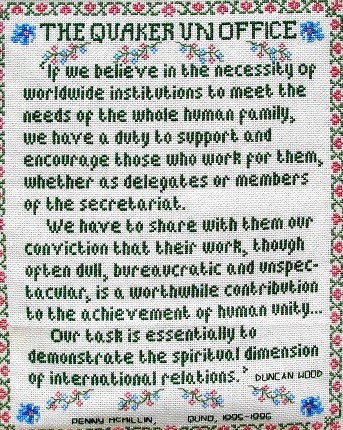
So, why work with such an institution? I came to some clarity on this question when I was in Brussels. The keynote speaker at a Quaker Peace Conference pointed out that we don’t stop engaging with our national governments because they are not exactly the institution we would like them to be. Indeed, he pointed out that it is for this reason that we should engage most vigorously with them. The role of my organisation is to engage with the world's government. By advocating for international positions on human rights, disarmament and fair trade and facilitating dialogue and understanding between government representatives, we can have an impact on the current system. We can also model the kind of international diplomacy that we would want to see throughout the UN.

Sunday, October 08, 2006

Turning on the heat

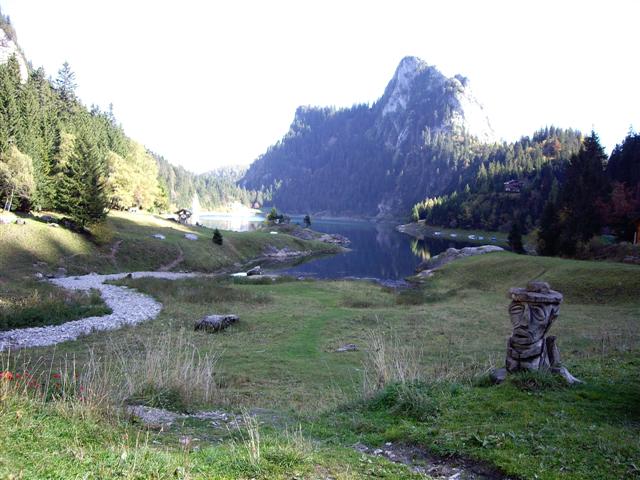
It's starting to get colder here, which is good, because I get to wear all my new winter gear!! The amusing thing about the Swiss heating, though, is that there is a day that it all gets turned on in Geneva (I think it's the third week in October). Every industrial or residential building is required to fall into line with this arrangement, regardless of their individual heating needs. I suspect they have a ceremony that week, too - probably involving cows. There are good things about the approach of winter. A few of us hiked up Le Grammont the other day and it was so nice to find ourselves in a Swiss chalet at the top of a mountain and to sip a well-earned chocolat chaud, huddled next to an open fire.

Things are also hotting up work-wise. Having found my feet, I am flying to Brussels this weekend to give a little presentation about Quakers and Peacebuilding. Determined not to hide my small flame of spoken french under a bushel, I have been letting it shine in various social contexts with encouraging results. For example, when approached with the invariable "why are you a vegetarian?" question, yet again, it was a welcome change to have the conversation in french!!! I have also been responding to emails in french, with a bit of assistance from my multi-lingual colleague, DZA.

Monday, September 04, 2006

All in a day's work

My workplace is a lovely old house with a beautiful garden. It has
four stories, including the attic (used as office space) and the cellar (used for meetings) and I am on the first floor. When I have been there a bit longer I should be pretty good at guessing whose feet are clumping up or down the stairs. One of my tasks is to arrange lunchtime meetings and I am pleased to report that my first one was accident-free. I have felt quite important running about getting my Swiss bank account and UN pass, but apart from the excitement of the perks of this job, I have realized how well respected the Quakers are in the UN circles and am feeling a sense of being part of something very worthwhile. I've been to quite a few UN meetings already, including one on cluster munitions in Lebanon, which was quite informative and disappointing at the same time. I'm also getting to know some of the other diplomats and NGO people who work on disarmament and they have been very welcoming.