Monday, January 27, 2014

Booked in


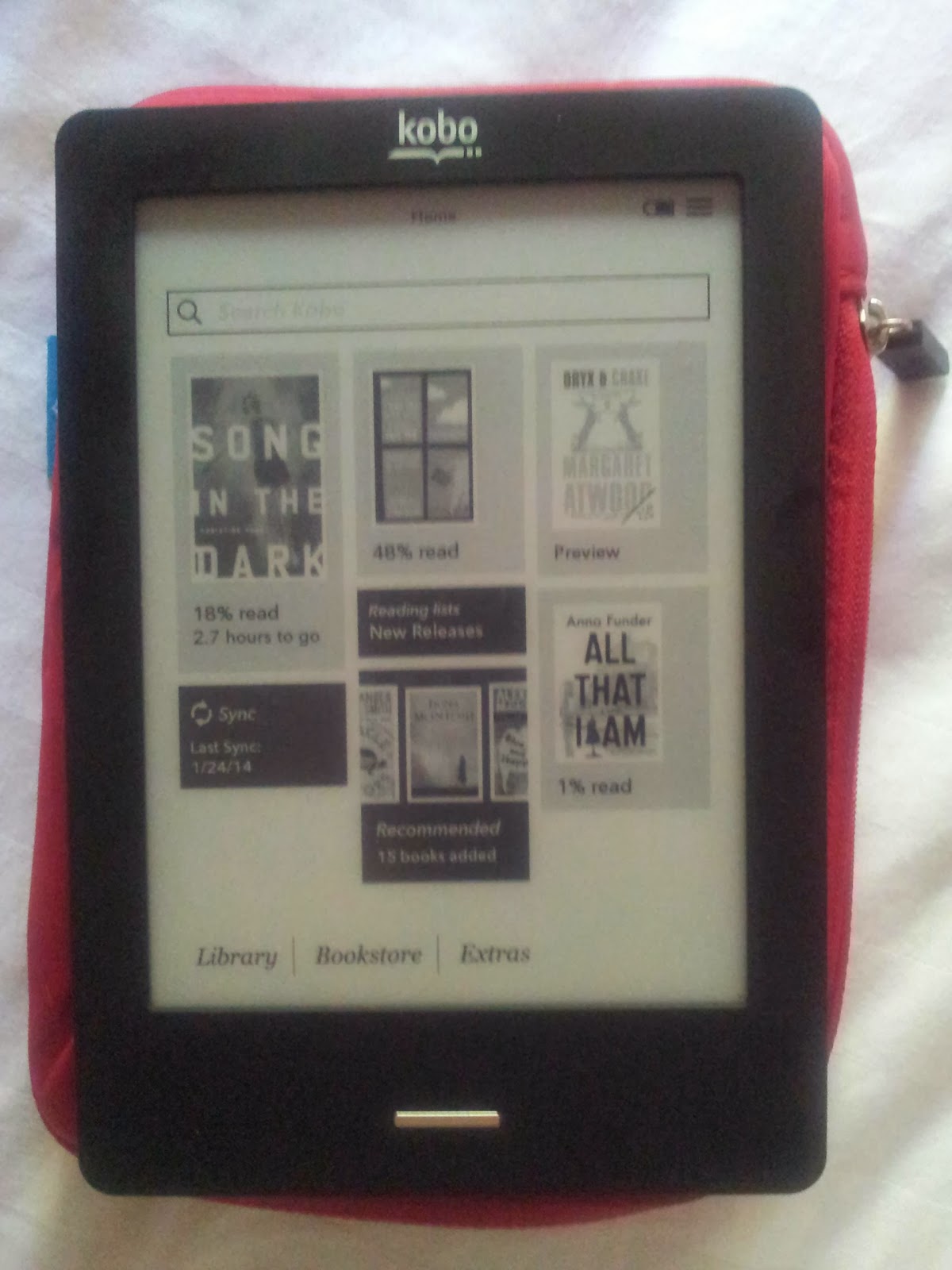
One of my end of year resolutions, if you like, was to solve the reading while travelling dilemma. Since I have been known to take month long trips to the Solomon Islands for work, with my suitcase half full of books, I had begun to feel that a 'kindley-type-thing' might be more practical than taking half my bookshelf with me each time. I also thought it might be more environmentally friendly in the long term.

The trouble is that I don't like doing what I call 'shopping research'. I just find it time consuming and I'm not that good at making decisions. Plus, all the options and permutations stress me out. I can happily go down one research path almost ready to commit, only to discover that it doesn't have a USB drive, or it only works in the northern hemisphere, and I have to start all over again. So, in a stroke of brilliance I decided to outsource the problem and happily put 'research the best kindley-type-thing for me to take overseas when travelling' on my santa list, and then put the matter out of my mind. I had vaguely thought that if my brother was my secret santa this year he might really enjoy doing this for me.

Best gift ever - the research done, AND beautifully presented!
Imagine my surprise and delight on Christmas day when I discovered that my secret santa (or kk as we call it in our family), who was the one family member with  "technologically challenged" as part of her email address, had completed the task with first class honours. Lovingly seeking the help of a technologically endowed librarian, my Kris Kringle had presented me with the alternatives, the ethical considerations, and a final recommendation, all presented nicely on blue card.

My new travel reading companion
Thus, I found myself purchasing a kobo (because my KK had explained to me the ethical fallbacks of going with Kindle/Amazon), joining my local library (because kobo is connected to the library network and I can borrow e-books), starting a bookclub and downloading my first books. It's all incredibly exciting. Now the only issue left is resisting the joy of browsing second hand bookshops. But buying the odd  "real" book is still ok, isn't it? I do still need something to read in bed when I'm not on the road!!

The bedside bookshelf remains

Saturday, January 25, 2014

Utopia

The other night I saw John Pilger's film "Utopia" at The Block in Redfern. Arriving late, I was wondering whether I'd find anyone to sit with or whether I would miss the beginning, but I needn't have worried. It seemed that Sydney's entire progressive community had turned out to see the film. The movie itself didn't get started until I was well and truly settled into my picnic spot surrounded by people I knew.

Photo taken by my friend Costa

At the beginning of the documentary we learn of the price people are willing to pay to stay one night in a luxury apartment by Sydney's breathtakingly beautiful harbour. This opulence is then juxtaposed with Utopia, a remote desert community just a few hundred kilometres north of Alice Springs, where a health worker describes the appalling conditions that people live in. In one particular house, the only toilet doesn't work most of the time meaning that raw sewage collects in the back yard, and they don't have the basic medical supplies for immunisations or to prevent diseases that are non-existent in the rest of Australia. Oh, and cockroaches have been found in children's ears.

The description reminded me of an incident in Balgo, another desert community set on the intersection of Warlpiri, Kukatja, and Ngarti lands a couple of hundred kilometres further north, where I journeyed in 2009 to attend The Kapulalungu Aboriginal Women's Association Law Camp. Arriving in town, I remember one of my travelling companions commenting loudly about the state of the sleeping quarters, citing cockroaches, dog poo and unwashed dishes scattered about the place as unacceptable, perhaps unaware that while our new room-mates might have been too shy to speak English with us, they understood the gist only too well. We were perpetrating again the shame we place on First Nations people because they are not like us, or because they don't have access to the basic sanitation facilities that we take for granted.

In that community I formed a bond early on with one lady who had recently lost her son to suicide. He was the third young person to die that way in the space of 12 months. As we shared snippets of our very different lives, I marvelled at her resilience. Some of her older female relatives remembered a time pre-invasion, before the middle generation had been raised in a Catholic mission school away from their families and prevented from speaking their language. These women were now teaching their traditional laws and customs to the younger and middle generations with the hope that re-connecting to culture would make a difference to self-confidence, cultural pride and a sense of healing for the community as a whole. Even after sixty short years, "settlement" had clearly been very destructive to the mental health of young people, evidenced in the high rates of suicide.

One of the buildings used for health and community work, Balgo

Rates of youth suicide amongst First Nations people was highlighted in the movie, with Robert and Selina Eggington from the Nyoongar Nation speaking about their own experience of grief losing a son to suicide, and then talking about a space of remembrance that they created for other grieving parents in the Perth area. I wished the movie had included more positive stories like this, and perhaps more from urban and rural experiences as well as remote. But I did find it valuable to hear about successful strikes and union activities that had led to increases in wages, improved standards of living and safety for workers. Stories of resistance movements and urban survivors could have been more prominent.

The irony in the connection between the Northern Territory Intervention and the Stolen Generation was explored. John Pilger reminded us that the Intervention was supposedly implemented because of John Howard's concern about rape of children by Aboriginal men in Northern Territory communities following the "Little Children are Sacred" report. Yet, such allegations were a complete misrepresentation of the report. Even more frustrating is the irony that it was the rape of Aboriginal women and girls by white men that resulted in the "half-caste" children who were stolen as part of a racist policies to breed out the black. Some of the books that tell the stories of the stolen children are so powerful, and I remember tears streaming down my face as I learnt of each person's unique but similar heartbreak. Since I was aware that my grandparents had fostered an Aboriginal girl in the 1960s, believing they were doing a good thing, I imagined with some discomfort every story taking place in their house.

The racism of newcomer Australians is evident in interviews with former politicians, people celebrating Australia Day, and countless stories of unnecessary deaths in custody and massacres that have gone un-noticed in history books. I am also disappointed by how this country has handled Australia Day, almost completely oblivious that our day of pride represents nothing less than invasion day for First Nations people. My sister-in-law tells me that she was shocked by the racism she noticed amongst settler Australians when she first moved here. As I continue to struggle with my own racism and privilege, I am filled with love for the First Nations people in my life who have opened their hearts to me over the years. I have a number of "uncles" who continually forgive me as I stumble and offend. They gently nudge me in the right direction.This movie is another step on my journey. I hope it is seen by those who need to see it, rather than only those of us who are "the converted" -  those of us well-intentioned lefties who want to be supportive, but still need a great deal more educating, mind you! And I hope this story will spark vigorous discussions. I reckon it's okay if we don't all like the style of journalism or the choice of content, as long as it gets us talking about our embarrassing history, the change we want to see in the future, and maybe even taking action in our own lives to be that change.

Saturday, January 18, 2014

The story of the extraordinary helping elephants

My feeling is that play and storytelling are closely intertwined with a child's social and emotional development. What might seem repetitive or boring to us, is an important exploration for the child of an idea or problem until there is resolution or understanding. I would like to share a story that my nephew Noah has been working on recently, starring a trio of wooden elephants and some adult friends playing minor roles as assistant puppeteers and storytellers ...

The director and storyteller with his elephants

Once upon many a time there were three elephants; a mummy elephant, a daddy elephant and a Noah elephant*. This happy family liked to bound exuberantly over the African plains. Then, suddenly and tragically, during the course of such joyful bounding, one of the elephants falls over. 

"What happened?" the mother elephant asks in a very concerned voice. 

"I falled down" explains the Noah elephant, or the Daddy elephant, depending on who fell. 

"Don't worry" soothes the mummy elephant, "I will rescue you", and efforts are immediately made to help. If the other two elephants can't put the fallen elephant back on its feet, a large rescue truck or fire engine with a crane can be brought in to assist.

The family bound off happily again, until another calamity erupts. This time the daddy elephant, because he is actually a puzzle, falls apart and find himself bounding off without his rear end. But again, disaster is averted with the assistance of puppeteers, match box cars or a dinosaur figurine, and all is well again with the world.

THE END.

This story, in all its variations, says a lot about the story teller's own world view. Just last week he adopted a kitten that was found abandoned on a bus. whenever it cries he says "don't worry meow". A few weeks ago he became distressed when at the aquarium, having noticed a lobster that seemed stuck against a rock and wondered whether in fact he should help this lobster out of its predicament. It was only when he was reassured that the lobster's friends would probably help him out that he was satisfied and able to move on to the next exhibit.

As I delight in this stage, I wonder how I can foster and encourage the empathy that I see emerging in my young relative. Probably adding variations of the story that involve the elephants farting loudly and saying "excuse me" probably wasn't the best way to do this, in retrospect, particularly when I am told he now likes to insert this variation into everyday tasks at shopping centres and other public places, much to his grandmother's embarrassment! But on a more serious note, I hope I can join in modelling good helping behaviour, and I applaud Noah for his dedication in tackling such an important theme. I recommend the helping elephant show as a must-see for all ages!

*Any reference to real people is purely co-incidental.

Saturday, December 21, 2013

The Jesus effect

There's been a bit of an Orwellian vibe about recollections of Nelson Mandela since he died. People who had previously called him a terrorist are now calling him a freedom fighter. World leaders are comfortable saying that he stood for forgiveness and non-violence, while conveniently forgetting to mention that he disn't always advocate for non-violence and the connections he drew between apartheid in South Africa and the treatment of Palestinians by Israelis and Indigenous Australians by settler Australians.

My fear is that history will re-write the story of Mandela in the same way that I think happened to Jesus. Enthusiastic Christians who can't help but maintain the structural violence of the church seem to equate Jesus with patriarchal, homophobic and oppressive beliefs, forgetting that Jesus was considered a terrorist by the Romans, was willing to take a stand against injustice in all its forms, and would have had far more in common with the more radical left of the modern church than with Tony Abbott and George Pell.

I remember reading an article by Walter Wink, a progressive Christian theologian, about Jesus' teachings from a non-violent social change perspective. It's called "The Third Way" and sheds new light on the "turn the other cheek" passage. His message was possibly more like training for freedom riders and radical activists than a message of passivity.

When the slappee turned the other cheek, the slapper is faced (excuse the pun) with a dilemma; they must choose between using their left hand (unclean) or using a backhanded slap (only delivered to children or slaves, so makes them look really bad) to slap the other cheek.Taking all the clothes from your back and standing there naked is another way to humiliate the oppressor, as apparently nakedness was as much an embarrassment for the viewer as the one who was naked. Carrying the soldier's pack a second mile infringed the military code and created a dilemma for the soldier.

So, according to Wink, Jesus was never suggesting that people passively resist, he was giving them clever tools for resisting, humiliating, and surprising their oppressors. They were techniques for taking back power through creativity and surprise.  The important thing for me is that Jesus, like Mandela, didn't stand for passive resistance, forgiveness without justice or maintaining structures of violence.Yet, the story has been diluted over time and we rarely hear Jesus referred to as an activist or freedom fighter anymore.

So, I hope that when we remember Mandela, we remember the entire, complicated, human and committed man that he was, and note that he questioned and opposed oppression and apartheid everywhere, right up until his death. And I hope we don't try to squeeze him into a convenient box that fits the current political climate.

Wednesday, December 04, 2013

The bad day

It was one of those days. My morning had consisted of burning a cooking pot to a crisp while watching the Alec Baldwin version of "A streetcar named desire", followed by dashing back and forth between doctor and imaging people for 3 hours to get a redundant x-ray result. Now, after hobbling from the car to the 'old' dentist and hobbling more frantically to the 'new' location, I was seated in the dentist's chair with a mouth full of flouride solution and an ice pack on my aching toe (clever use of time, i thought). To top it all off I had left my phone at home so was unable to confirm a catch up with a friend. I began wondering what else could go wrong.

The dentist, however, was a very up- beat sortof guy, and he gave me a new perspective. Adapting easily to his first (and possibly only) frozen peas-on-the-foot-of-the-patient scenario with enthusiasm, and after the usual chit chat, and the right amount of toe-related sympathy, he got to work. "Well, you don't need any fillings" he announced cheerily. "See, there's always something good happens even on bad days" he added, and i couldn't argue with his reasoning.

So, as I rinsed, and spat, and promised yet again to floss more often, i reminded myself that i have lots to be grateful for - friends who forgive me when I mysteriously don't respond to phone messages, beautiful strawberries growing in our garden, the fact that I didn't burn down the entire house, no fillings, and the kindness of strangers!! Life's not too bad after all.

Wednesday, November 27, 2013

A caterpillar's heart

Recently I chanced upon an old friend at a work event. We had lost touch, and it took us a while to place one another. After a few attempts at "did you work here?" and "are you involved in such and such a cause" he hit upon the connection. We had studied psychology together at Macquarie University back in 1995. 

He showed me pictures of his children, and we reminisced about those carefree, and occassionally not so carefree, days of our youth. Then, out of the blue, he told me that he had remembered me as a beautiful soul, somebody he had admired. My reaction at the time was delight and surprise, as I saw such high praise as representing how i had hoped to be, but not who i was. I had thought of myself more as somebody who was not yet fully formed, a chrysalis, if you will. And I still think I have a long way to go before I emerge triumphant and colourful from my cocoon. There are so many ways that I could be more compassionate, more considered and more humble.

butterfly image on a handmade card

In pondering this matter, and thinking of many old friends who are still incredibly important to me, I was reminded me of a poem my mother wrote in my autograph book when I was about ten years old. These autograph books were kindof like the facebook of the 1980's. You took it around to everyone you knew and they wrote thoughtful, complimentary or funny things in it. Mum's message has stayed with me, even though the autograph book has been long since lost, because of the beauty of the words she wrote: 

"A caterpillar's heart still beats in every butterfly. Inside you are always you. Inside you are always you". -
I like to think that, even as we grow and change, we are the same person on the inside and that's why it's so easy to pick up a phone conversation as if two decades had not passed, or camp together as if still in our 20s. 

As my new-old friend and I talked in the car on the way home, about lots of deep and spiritual matters, I caught a glimpse of that beautiful soul being re-awakened, of the person I had always hoped to become. With this new-found sense of my own beautiful soul, I feel encouraged to go about life seeking out that beauty in others, or to use the Quakerly quote "walk cheerfully over the earth, answering that of God in everyone". I intend to be brave enough to tell people about their beautiful soul when I particularly notice it, because life is short and we are all precious.

Aspirational street art in Surry Hills

Sunday, November 10, 2013

Family Maiden Aunt

With my brother's wedding coming up, it has dawned on me that I am in that slightly uncomfortable place that Bridget Jones was so well known for -  being single and childless. Yep, I'm now the family maiden aunt. But don't worry, I'm not completely alone. Apart from good ol' bridget, there is also a close family member not in a committed relationship... my three year old nephew!! So the two of us singles will be bunkmates for the duration of the wedding. Sigh. Back home, things are not much more impressive. I'm living in a share house again, and my assets include a wardrobe that I found on the side of the road, a chest of drawers that has been with me since childhood, and my shoes are lovingly arranged on four bricks and a length of wood that was lying about in our garden. All that's missing from the picture of the poverty stricken, lonely spinster is a cat.

Not a bad companion, really

And like Judy Small, in her ditty about being the family maiden aunt, I may have experienced some inadvertent sighing and shaking of heads from extended family members. Topics of inquiry in my early thirties focused on things like "when are you getting married?" and "do you think you'll have kids?" Now that all that's been covered, and it seems apparent that I won't do either, there's just an awkward silence. Some people are almost too enthusiastic about my work - possibly afraid to touch on more personal matters, some seem wistful and a bit starry eyed when we talk about the things I have done recently like travel and work and activism and adventures. With others there is definitely the impression that I have taken the easy, selfish road.

So, I guess I want to explain. When I was younger I did imagine myself as a parent and a partner. I had a dream that I still occasionally indulge in... it's of a slightly rural, sustainable house, with a vegie patch, chickens, kids, and maybe even a few children. (The kids are the young goats, if that wasn't clear). During my teens and then again in my late twenties I spent a lot of time babysitting and as a nanny. I would return home utterly exhausted, but happy -  boring friends and family with stories of how Connor insisted we start populating his ant farm then and there, or how Lexi so beautifully explained to me why she was angry and what her needs were. Definitely the most rewarding work I have ever done has been with children, so I have some idea of what I'm missing out on. But don't feel pity for me. I've made some choices in life that have taken me on a different path. It's taken a fair bit of "work" for me to get to that place of acceptance, recognising that where I am is a result both these choices and the cards I've been dealt, but I'm pretty much there now.

I am okay with this, because I know there are certain things that I can do because I'm not tied down. There are perks. I can do the work I love without worrying about anybody missing me back home when I travel. I can be the person who attends a rally, or evening meeting because I don't have other obligations. I can fly down to Hobart to spend my day off with my nephew and or spend it helping a friend. I can walk the Overland Track for five days. I can sleep in on a Sunday.  And I am not under any illusions about how hard parenting can be sometimes. I have seen my own parents, and now most of my friends, at the end of their tethers, and struggling to keep it together at times. I take my hat off to you all. But don't envy me. You made your life choices, and there are perks for you too - cuddles in bed on a Sunday morning, 50 million facebook likes because your child just blew a bubble, and knowing that somebody small loves you a whole lot.

The perks - having adventures AND cuddles
Then there is the thing about leading a meaningful life. I have heard so many people say things to me like "my job was getting a bit dull, so I thought having kids would give me a purpose again" or "this parenting gig is the most rewarding role I have ever taken on". Sometimes I feel judged because there's an unspoken assumption that the only way to find meaning in life is through having children, and by extension, if you don't have children your life must be fairly meaningless. Occasionally I have bought into this view, and judged myself quite harshly as a result. But, when I think about the parents I really admire, they are the ones who are already engaged in lots of activities, and care about issues. Their children simply augment their lives rather than providing all their raison d'etre. Secondly, many people whose lives were particularly meaningful because they changed history through leading significant social or spiritual movements, were either childless or received criticism for abandoning their children and partner in preference for this spiritual or ethical cause. I recently read that the Buddha left for a 6 year pilgrimage soon after his first child was born. Sometimes I think there is so much to be done in the world, that we need a certain proportion of single, childless people to do the other, non-child-related meaningful stuff, unencumbered by family obligations.

So, luckily the wedding is going to be a very inclusive one, and outside of our immediate family there will be lots of people there who don't fit the conventional mould, many of whom are close friends of mine. And sometimes I feel so touched that my beautiful friends with children want to connect with silly old me, and I am reminded that we will always have our values and love for one another in common, even if we don't share being parents. But, if you find yourself feeling awkward about talking with me at the wedding or any other event, remember that I might have taken a different path, but I'm not from another planet, and I am able to engage in conversation on a number of topics, including other people's partners and offspring. I don't want to be treated with pity, envy or judgement. I would love, though, to find out what's really happening in your life, and what gives it meaning. And who knows what the future will hold. Perhaps I'll foster, adopt or step-parent some amazing little people one day, and then we can talk about that too!

Monday, October 07, 2013

Bandaid solutions

Over the past few days I have had a rather high number of paper cuts. I think they must be 'going around'. Because of the disproportionately high level of discomfort caused by such small cuts, I have taken to applying band-aids and this got me thinking about the old band-aid analogy.

I am pretty sure there are two types of people. Those who like to rip band-aids off quickly, and those who prefer to peel them off bit by bit over the course of a number of days/weeks/months. I have a lifetime membership of the latter category. As a child I would take a daily stocktake of the state of the knee and its covering, taking a significant amount of time out of my busy schedule (not) to work on the task of gently separating the two, bit by bit. Being a deliberator and a 'thoughtful' person, I am not one for hasty decisions and have always hoped that if I peel slowly enough, the pain will be diluted to the point of being unrecognisable as pain.

This year I have learnt that the same band-aid solutions tend to be applied to matters of the heart. Some people prefer to take quick and decisive measures while others like to linger. Even when all logical and practical indicators point to the fact that the band-aid needs to come off at some point, I still prefer to peel it off gently, hoping again to dilute the pain. Probably frustrated with this situation of band-aid “no-man’s-land”, I have had the band-aid unceremoniously ripped off once or twice by the other person, in the same way as a frustrated mother who is tired of watching that child painstakingly edge the flapping and grubby plaster from their knee will swoop in and rip! And, like the small child, I am left a little bewildered and unsure about whether to be indignant or secretly relieved.

This state of affairs has left me wondering whether there are in fact times when it's better to just "rip" and get it over with. Perhaps ripping is not so bad. Maybe it can be freeing, and positive, and bold. So, in an unprecedented move, I decided to rip off the band-aid that had been on my paper-sliced finger - just to see how it felt. And then I just ... walked away!! Ah, not so bad after all. In fact, I think it means my finger is now truly ready for its next adventure without carrying around any excess baggage, so to speak.

Sunday, September 29, 2013

Big foot

It turns out that I might be ....the weakest link in my household. We were taking a bit of an audit of electricity usage and as it happens, my heater uses *a lot* of our household electricity. I was a bit confronted by this information, as I think of myself as having a relatively light ecological footprint. I am a vegetarian, for crying out loud! I compost, grow stuff, refuse plastic bags, use public transport where possible and never use a clothes dryer. (Please don't get me started on people who use dryers!!). Surely all that counts for something?

But this situation I find myself in has caused me to reflect on how easy it is to become holier than thou on one aspect of our ecological footprint while ignoring other less comfortable areas.I also wonder whether I am perhaps focusing too much on low impact lifestyle changes and too little on the areas of greatest impact. So I decided to find out for myself which lifestyle choices can make the biggest difference to the environment. Thanks to the World Wildlife Fund online calculator, I have been informed that I am indeed a big foot - I'm using the equivalent of 1.7 planets or almost double my share. The average Australian uses the equivalent of 3 planets.

My ecological footprint results


So, what else did I discover? One of my biggest areas of impact is food. Initially I was surprised. A UN study entitled "Livestock's Long Shadow", indicates that eating meat is the number one consumer cause of global warming, above all types of transport combined. And according to the "What if" section below, if every Australian reduced the amount of animal products they consumed, we could reduce our ecological footprint by 18 million hectares! Yet, food is one of my biggest percentage items. I guess even a vegetarian diet takes a lot of agricultural land. Apart from going vegan or just eating less, which is probably not a bad idea, I can reduce the amount of packaged and imported foods that I consume. If Australians were to reduce the amount of packaging they use, we could reduce our footprint by 14 million global hectares!

My other big area was services. It seems that I am at the same time good (high use of public transport and recycling services), bad (high use of waste services, packaging, and possibly transport related to imported food) and confused (high electricity usage - but if it's renewable is it okay to use more?) which makes it hard to assess whether having a high percentage on the services slice of the pie is a good thing or not. However, given that the amount of land I use for energy is so high, that is one area I can definitely improve upon. If more Australians reduced their electricity usage through more efficient appliances, we could reduce our footprint by 2 million global hectares. If more Australians had solar panels (thereby reducing their *bad* electricity usage down to zero) we could reduce our footprint by 9 million global hectares.

Interestingly, although I travel by plane a lot for work, mobility was not my worst area. The fact that I mainly travel in Sydney by foot, bike, and bus apparently compensates for all the flying I do. Apparently if the average Australian reduced their car usage and increased their use of public transport, we could reduce our footprint by 9 million global hectares. Flights do contribute to 1 million of Australia's global hectares, however, so it's something I need to think seriously about.

Shelter was my smallest slice of the pie, possibly due to the fact that I live in a modest sized house with four others. We can share things that take up a lot of energy like a fridge and also be part of a food co-op. Interestingly, there were not any questions about how many children I have and whether the people I lived with were the result of my own procreation or somebody else's. I felt that should have been asked. An article entitled "The 5 most important things you can do for the environment" lists having fewer or no children as the number one thing we can do. While I take off my hat to those who choose not to have children for the sake of the environment, it's nice to know that my situation (childless, as one friend so delicately put it) lightens my impact somewhat. I'd like to know how many global hectares I'm saving through this sacrifice on everyone else's behalf!!

Interesting to note which areas can have the biggest impact

So while I'm still the weakest link, I probably won't be voted out of the house. They are a very reasonable bunch! But there's plenty of room for improvement. One day I might just have a job where I travel less, reduce my waste and packaging even more, eat vegan and local, and yes, be warm in winter because of my amazingly insulated green house that is heated using passive solar and boosted by as much solar energy to power that heater as I care to use! Ahhh! But until then, I plan to rug up, or take the advice of the student residence in Switzerland when the heating system broke down - go hug a flatmate! 

Sunday, September 01, 2013

Swimming goggles, lemons and a clanging noise

During a recent visit to Istanbul, I found myself closer to the action in Taksim Square than I had expected. Although it was just after about a month of regular protests and police involvement leading to some violence, the previous week had been very calm, and the hotel staff assured me that everything was fine. So, it seemed that I was still "exercising extreme caution" in DFAT's terms if I merely ventured across the Galata Bridge and into town to meet some friends at a cafe.

Street in Istanbul pre-gas
Given that Istanbul was the only city on this trip where I literally knew nobody, I was very grateful for the contact, and to be able to hang out with locals. I ordered a lemony drink and began asking my new friends all about their jobs and what brought them to Turkey. As we were talking, I glanced at the shelf behind, and noticed a pile of leaflets announcing a rally to be held the next day. I took a flyer, noted the place and time, but contrary to my usual practice, it was in order to avoid being there. My new friends agreed that I could do more for the cause by staying safe and joining in the online campaign than getting physically involved.

Then, as we were wandering down the cobblestone street and considering where to go next, we came across some people running down the hill quite quickly, in the way that I imagined a stampede might begin. I didn't know which way to turn, and was reminded again that I am not good in emergencies. My new friends ushered me into a nearby bar, but not before I was exposed to a faint gassy smell, and my eyes began to water. Police had begun to spray tear gas on protesters again and we were in the firing line.

Once we were safely inside the bar and things had quietened down, my new friends started telling me stories about the situation so far. They lived very close to Taksim Square and had heard the events unfold quite literally before their teary eyes. One guy reckoned he had been gased by proxy about 20 times in the past month. As we sat there, small groups of people walked past the window with mouths and noses covered by gas masks, handkerchiefs, and interestingly enough, swimming goggles. We did wonder where all the swimming goggles were coming from, and whether any suppliers thought it odd that they were suddenly in such high demand. They also mentioned that within a few hours of the first incidents, enterprising street vendors were spotted selling gas masks, lemons and other useful items that one might wish to purchase post-protest, in much the same way that there is always somebody selling umbrellas the minute it starts to rain. 
protest flyer

Stories of creativity and humour started to emerge as well. Apparently the government had been making some comments about people "making noise for no reason", so people had decided to do just that and began clanging pots and pans randomly as they went about their everyday business. Even when people were running past us with tears running down their faces from the gas, nobody turned on each other. There seemed to be an overall feeling of good-will, and I couldn't help being reminded of classes in Nonviolence with Stuart Rees, who talked of historical figures such as Gandhi and King using humour, creativity, and retaining their *human-ness* in the face of oppression or violence.

I spent the next day taking ferry rides and exploring the less touristy parts of town. It was great fun, particularly as Sunday is family day and "day off" in Istanbul, so everybody was out and about enjoying the sunshine and parks. As I reflected on this, I realised why access to a park in the centre of town was so important to people. As the hotel manager told me, the police also have families, and enjoy parks, so it is perplexing why they respond with such vigour to essentially non violent protests about an issue they themselves would most likely support, if they thought properly about it.